

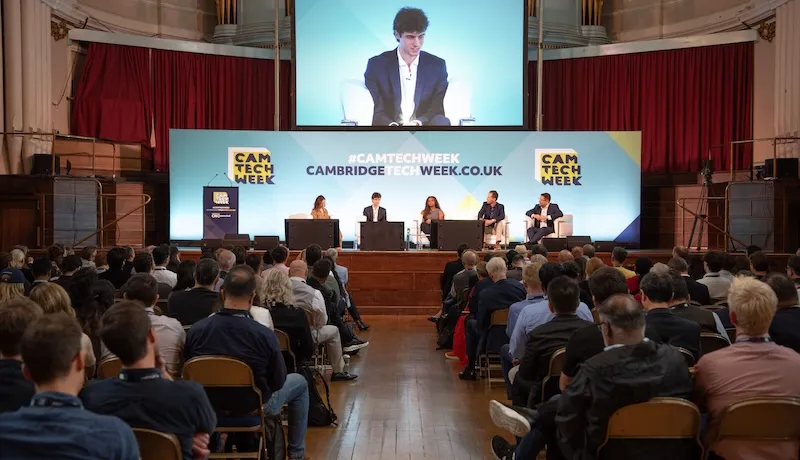
Cambridge Tech Week 2026 attracted more than 1,700 delegates from 52 countries, a 15% increase on the previous year, as the five-day gathering placed deep tech commercialisation at the heart of its programme.
The event ran from 14 to 18 September under the theme How Deep Tech Changes the World. It brought founders, investors, researchers, policymakers and technology companies together for discussions spanning artificial intelligence, quantum computing, healthtech, energy, infrastructure and security.
While the headline attendance figure underlined the event's growing international reach, the substance of the week reflected a broader shift in the technology sector. Deep tech ventures, which are built on scientific discovery and engineering breakthroughs, are increasingly being asked to show how they can move from laboratory research to commercial products, scalable businesses and real-world deployment.
Key Facts at a Glance
- More than 1,700 delegates from 52 countries attended Cambridge Tech Week 2026.
- Attendance rose 15% compared with 2025.
- The event was held from 14 to 18 September under the theme How Deep Tech Changes the World.
- The programme covered AI, quantum computing, healthtech, energy, infrastructure and security.
- More than 80 emerging companies and scaleups exhibited at Innovation Alley at Cambridge Guildhall.
- Myonerv won the 2026 pitch competition for a wearable neurostimulation technology aimed at helping stroke patients regain movement.
- Agritech startup LAMBDA was named People's Choice winner for advanced photonic materials designed for greenhouse agriculture.
- The two pitch winners shared a £7,500 prize.
- International delegations came from countries including Finland, Romania, Estonia and Serbia.
- The British-Serbian Chamber of Commerce brought more than 20 companies, with eight Serbian businesses exhibiting.
- Sessions examined AI energy demands, sovereign computing, dual-use technology and the civilian-defence boundary.
Deep Tech Moves From Research Labs to Commercial Markets
Cambridge has long been associated with scientific excellence and technology spinouts. The city's ecosystem includes a dense network of university research groups, hospital and biomedical campuses, venture investors, specialist consultancies and scaleup operators. That combination has helped Cambridge become a recognised hub for fields such as AI, quantum technologies, biotech, medical devices and advanced materials.
But the transition from research to commercial business remains difficult. Deep tech companies often face long development cycles, high capital requirements, complex regulatory pathways and the need for specialised talent. The most pressing questions at Cambridge Tech Week 2026 centred on how to bridge those gaps: how to finance expensive laboratory work, how to prove safety and efficacy, how to build manufacturing capacity and how to connect researchers with industry partners that can adopt new technologies at scale.
Commercialisation, access to investment and researcher-industry collaboration featured prominently across the programme. So did the infrastructure required to support emerging technologies. AI and quantum computing, in particular, require significant computing power, energy, cooling and secure data infrastructure. Those demands are shaping investment decisions and policy debates far beyond the laboratory.
Startups Take the Stage
More than 80 emerging companies and scaleups exhibited at Innovation Alley at Cambridge Guildhall, giving early-stage teams a platform to demonstrate products, meet investors and test market interest. The event's pitch competition showcased a group of early-stage technology companies, with judges and attendees recognising ventures that combined scientific depth with a clear commercial path.
Myonerv won the 2026 Cambridge Tech Week Pitch Competition for its wearable neurostimulation technology, which is being developed to help stroke patients regain movement. The startup was founded by chief executive Sam Kamali. His motivation for developing the technology followed a deeply personal experience: his cousin suffered a stroke aged 11 after a bleeding brain tumour caused by previously undiagnosed leukaemia.
That story illustrates the human impact that can drive deep tech innovation. Neurostimulation is a field that sits at the intersection of medical devices, neuroscience, software and clinical validation. Bringing such a product to market requires rigorous testing, regulatory approval and close collaboration with clinicians. The pitch competition win gives Myonerv visibility and early validation as it works to develop its technology.
Agritech startup LAMBDA was named the People's Choice winner. The company is developing advanced photonic materials designed for use in greenhouse agriculture. Photonic materials can influence how light interacts with plants, potentially improving growth conditions, energy efficiency and crop performance in controlled environments. The two companies shared a £7,500 prize.
International Participation Expands the Conversation
The event also attracted a significant international presence. Delegations attended from countries including Finland, Romania, Estonia and Serbia, reflecting the cross-border nature of deep tech development. Innovation increasingly depends on global talent, supply chains, investment and markets, and Cambridge Tech Week provided a meeting point for those networks.
The British-Serbian Chamber of Commerce brought more than 20 companies to Cambridge, with eight Serbian businesses exhibiting across areas including AI, telecommunications, cybersecurity, agritech, healthtech and biotechnology. That presence highlighted how deep tech ecosystems are developing beyond traditional hubs. Countries with strong engineering and scientific traditions are looking to connect with established clusters such as Cambridge to access expertise, partners and capital.
For founders, the value of such international delegations is not only in exhibition space. It is in the conversations that happen around the edges of a conference: investor meetings, research collaborations, pilot projects, customer introductions and recruitment. Those interactions can be difficult to measure, but they are often the foundation of long-term commercial relationships.
Infrastructure, Energy and Policy Take Centre Stage
Other parts of the programme focused on the infrastructure and policy challenges associated with the next generation of technology. Sessions examined the growing energy demands associated with AI, sovereign computing capabilities and the increasing crossover between civilian and defence technologies.
AI's energy footprint has become a major concern as models grow larger and data centres consume more power. The demand for electricity, cooling and land is forcing governments, utilities and technology companies to rethink infrastructure planning. Quantum computing adds another layer of complexity. Although still in its early stages, quantum technology could eventually transform fields such as drug discovery, materials science, logistics and cryptography. It also raises questions about sovereign capability, export controls and national security.
The Big Tech Debate focused on dual-use technology and the changing boundary between civilian and defence innovation. Many technologies developed for commercial markets, including AI, drones, sensors and advanced communications, can also have defence applications. That overlap creates opportunities for investment and growth, but it also raises ethical, regulatory and reputational questions for founders and investors.
Separate sessions examined the development and commercialisation of AI, quantum and health technologies. Across those discussions, a common theme emerged: the pace of scientific progress is not matched by the pace of commercial adoption. More capital, better policy coordination and stronger collaboration between research institutions and industry are needed to turn promising discoveries into products and services that can scale.
Voices From the Programme
Speakers during the week included BenevolentAI founder Kenneth Mulvany, author Calum Chace, CMR Surgical co-founder Mark Slack, Balderton Capital general partner Suranga Chandratillake and LinkGevity founder Dr Carina Kern. Their participation reflected the range of expertise required to build deep tech businesses, from artificial intelligence and robotics to longevity research and venture investment.
Michaela Eschbach, chief executive of the organisation behind Cambridge Tech Week, said: 'Cambridge Tech Week was a powerful demonstration of Cambridge's global leadership in deep tech.'
She added: 'Across five extraordinary days, we brought together the people, ideas and technologies with the potential to change the world, creating connections and conversations that will continue long beyond the event itself.'
The 15% rise in attendance suggests that demand for these conversations is growing. As deep tech moves further into the mainstream of economic policy and investment, events that connect science, capital, industry and government are likely to play an increasingly important role. The challenge for Cambridge and other clusters will be to ensure that the connections made during a five-day event translate into lasting companies, jobs and solutions.
For the startups on stage, the week offered more than recognition. It provided access to a network that can help them navigate regulation, raise funding, recruit specialists and find early customers. For investors, it offered a view of technologies that may take years to mature but could have outsized impact. For policymakers, it highlighted the infrastructure, energy and security questions that will shape how deep tech develops.
The pitch competition winners illustrated both the promise and the difficulty of that journey. Myonerv's neurostimulation device addresses a serious medical need, but it must pass clinical and regulatory hurdles. LAMBDA's photonic materials could improve controlled-environment agriculture, but they must be manufactured and adopted at scale. Their success will depend not only on scientific ingenuity but also on the strength of the ecosystem around them.
That ecosystem was on display across Cambridge Tech Week 2026. From Innovation Alley to the Big Tech Debate, the programme connected the laboratory to the market, the local to the global and the technical to the political. The conversations may have ended after five days, but the work of turning deep tech research into commercial businesses is only accelerating.
Source:UKTN News