

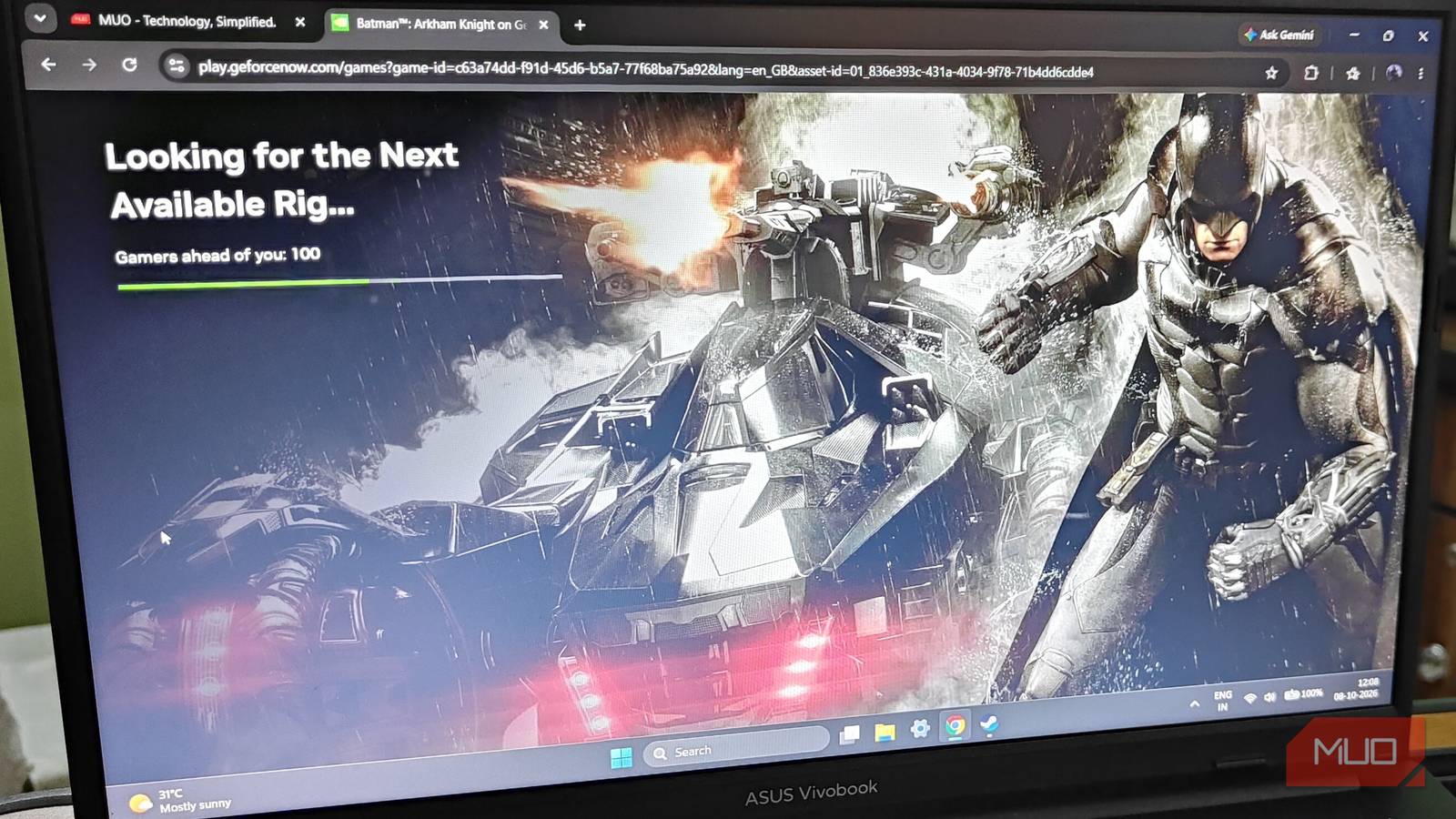
Cloud gaming has long promised a future where hardware limitations no longer dictate what players can enjoy. The idea of accessing a favorite game on almost any device, at any time, without buying a high-end PC or console, is a fascinating proposition. When Nvidia GeForce Now finally became available in a new region, it seemed like the perfect opportunity to test that promise. On the surface, the concept is excellent: pay a small monthly fee and gain access to games from a Steam, Epic Games, or Xbox library on any device with an internet connection.
Initially, the experience was genuinely enjoyable. The service worked well enough to justify a subscription, and it even led to upgrading to the highest tier. However, after about a month, the cracks began to surface. While cloud gaming may be an inevitable part of the industry's future, Nvidia GeForce Now, at least in its current form, is not the definitive answer.
Nvidia GeForce Now Offers a Lot, but at a Price and With Multiple Caveats
Subscription tiers and promises
On paper, Nvidia GeForce Now is an excellent way to enter the cloud gaming ecosystem. It essentially provides access to a mid-spec PC for a small monthly fee, without restricting which games a user wants to play. Unlike Google's failed Stadia, players do not have to buy games from scratch. Instead, they can carry over an entire Steam or Epic Games library and play whatever is supported.
Higher subscription tiers promise access to high-end PCs equipped with the latest RTX GPUs. The service offers three main tiers, each with different pricing and performance targets.
| Tier | Monthly Subscription Price | Ad-supported | Maximum Resolution and Frame Rate Targets | Gaming Sessions | Priority Queue | CPU and DRAM | Access to Nvidia RTX GPUs |
|---|---|---|---|---|---|---|---|
| Free | Free | Yes | 1080p at 60FPS | 1-hour sessions | No | 4-core vCPUs and 16 GB DRAM | No |
| Performance | $9.99 per month | No | 1440p at 60FPS | 6-hour sessions | Yes | 8-core vCPUs and 28 GB DRAM | Yes |
| Ultimate | $19.99 | No | 5K at 360FPS | 8-hour sessions | Yes | 16-core vCPUs and 56 GB DRAM | Yes |
Following a closed beta test, the $9.99 Performance tier was the first stop. It allowed games like Cyberpunk 2077 and Street Fighter 6 to run on an older work laptop, an ASUS Vivobook. For the first month, GeForce Now was genuinely fun, especially on an older Steam Deck. In fact, most gaming time was spent on the service instead of a dedicated gaming rig.
After the first month, however, the experience declined. Lengthy queue times appeared even on the paid Performance tier, which promises less than a minute of wait between sessions. The Ultimate tier was not faring much better. Just to test it, the plan was upgraded to Ultimate, and there was still a wait of roughly 10 minutes before playing The Witcher 3: Wild Hunt Remastered or Monster Hunter Wilds. Long queue times are not unusual for cloud gaming services, but when paying a premium that promises minimal waiting, a 10 to 15 minute delay is unacceptable.
Streaming quality, input delay, and hardware dependence
Even when games finally loaded, it never felt like a premium cloud gaming service. On the Performance and Ultimate tiers, visuals could look impressive, but only when they worked. Most of the time, streaming quality sat somewhere between 1080p and 1440p, which never felt good to look at. Additionally, regardless of whether a keyboard and mouse or a controller was used, there was always an input delay.
Weirdly enough, streaming issues only occurred when using a laptop for GeForce Now. On a more powerful PC, on the same network as the Vivobook, streaming hitches were less frequent, with resolution mostly staying locked to 1440p. This suggests that GeForce Now is very hardware-dependent, even when it is simply streaming games from a data center. The local device still matters, and older or less capable hardware can struggle to decode the stream smoothly.
Catalog limitations
Then there is the limitation of which games can actually be played. While Nvidia claims that GeForce Now supports most major releases of the last four to five years, the list is fairly limited. Most supported games are free-to-play titles that, surprisingly, can also be played on a mobile phone. The catalog is restricted to games that explicitly support Nvidia's technology.
For instance, while niche titles like Lost Ark or Path of Exile are available, there is no luck with any FromSoftware titles, whether Dark Souls or Elden Ring. That limitation matters because cloud gaming is only as good as the games it offers. A service can have powerful GPUs and low latency, but if the biggest and most requested titles are missing, the value proposition weakens significantly.
There Are Better Alternatives to GeForce Now
Cheaper cloud gaming options worth a shot
While the time with GeForce Now has not been great, that does not mean it is a poor service. When it works as intended, GeForce Now is perhaps one of the best cloud gaming services out there for its price. Unfortunately, more often than not, it does not work as wanted. Users are left with a monthly subscription that still hits them with long queue times, limited playtime, and an inconsistent streaming experience.
Thankfully, there are compelling alternatives that can be tried right now. Each has caveats, whether a limited library or a more expensive subscription tier, but they are the best alternatives to GeForce Now available on the market.
| Cloud Gaming Service | Monthly Subscription Pricing | Subscription Add-on | Games Catalog | Supported Platforms |
|---|---|---|---|---|
| Xbox Cloud Gaming | $23.99 (Xbox Game Pass Ultimate/PC) | No | Xbox Library and Game Pass catalogs available. | Windows, Xbox Series X|S, Xbox One, and mobile. |
| Amazon Luna | Included with Amazon Prime subscription | Premium tier add-on for $9.99 | Small catalog of games, including Triple-A and select indie titles. | Windows and mobile. |
| Boosteroid | $16.89 for the Ultra tier | Ultra Pro upgrade available at $74.89 (for 6 months) or $134.89 (for 12 months) | Select Triple-A titles and free-to-play games available from the user's own Steam library. | Windows, Linux, Tizen, WebOS, and mobile. |
In practice, Xbox Cloud Gaming proved to be a much better option for cloud gaming requirements over GeForce Now. It allows streaming an Xbox library as well as the latest Game Pass catalog of titles, without having to worry as much about latency or streaming quality. The integration with an existing Xbox ecosystem is a major advantage, especially for players who already own digital games and want a consistent experience across devices.
Amazon Luna is another option, particularly for those already subscribed to Amazon Prime. The base service is included with Prime, and a premium tier add-on unlocks more games. The catalog is smaller, but it includes a mix of Triple-A and select indie titles. For casual players, the convenience of a bundled subscription can outweigh the limited library.
Boosteroid offers a different model, focusing on streaming games from a user's own Steam library. The Ultra tier costs $16.89 per month, with Ultra Pro upgrades available for six or twelve months at higher upfront prices. It supports a wide range of platforms, including Windows, Linux, Tizen, WebOS, and mobile. The ability to play select Triple-A titles and free-to-play games from Steam is appealing, though the catalog is still restricted to supported titles.
Cloud Gaming Is an Alternative, Not a Replacement
For someone who grew up playing games on a PC, cloud gaming has never really sparked interest beyond its technological implications. It is a novel idea to let people enjoy games regardless of hardware boundaries. With the current market situation of PC components and even consoles, cloud gaming seems to be a superb alternative for players who cannot afford a dedicated gaming rig just yet.
With that said, cloud gaming is still very much in its infancy. As such, it is unlikely to replace traditional PC or console gaming any time soon. Services like GeForce Now and Xbox Cloud are great options to have as alternatives. They can be relied on when traveling and when carrying handheld PCs or consoles is not practical. However, they are never going to replace a dedicated gaming PC or even a Nintendo Switch 2 for that matter.
There is a certain charm to owning the system where you game. Cloud gaming, regardless of its many advantages, can never give the satisfaction of that ownership. Players who invest in a physical or digital library, customize their setup, and tune performance settings want control. Cloud services abstract that control away, and in return they offer convenience.
The technology behind cloud gaming continues to improve. Data centers are getting more powerful, codecs are becoming more efficient, and network infrastructure is expanding. Yet the experience remains inconsistent because it depends on factors outside the service provider's control: local internet quality, Wi-Fi stability, the age of the device used for streaming, and the distance to the nearest data center. Those variables explain why two players on the same subscription can have wildly different experiences.
For Nvidia GeForce Now specifically, the value proposition is strongest for players who already own a large library of supported games, have a reliable low-latency internet connection, and live near a data center. For everyone else, the queues, input delay, and catalog gaps can quickly outweigh the benefits. The service is not a bad idea; it is simply not a universal solution.
Competition in the cloud gaming space is healthy. Xbox Cloud Gaming leverages a massive Game Pass catalog and deep integration with Xbox consoles and Windows. Amazon Luna leans on Prime membership and a curated selection. Boosteroid appeals to players who want to stream their own Steam titles without buying a console. Each service targets a slightly different audience, and together they show that cloud gaming is not a single product but a category with multiple approaches.
Ultimately, the decision between GeForce Now and its alternatives comes down to individual priorities. If the priority is access to a personal Steam or Epic Games library with high-end RTX power, GeForce Now remains attractive on paper. If the priority is a broad included catalog with fewer hardware worries, Xbox Cloud Gaming may be a better fit. If the priority is low cost and a Prime subscription is already active, Amazon Luna can be enough. If the priority is streaming owned Steam games across many platforms, Boosteroid is worth considering.
Source:MakeUseOf News