

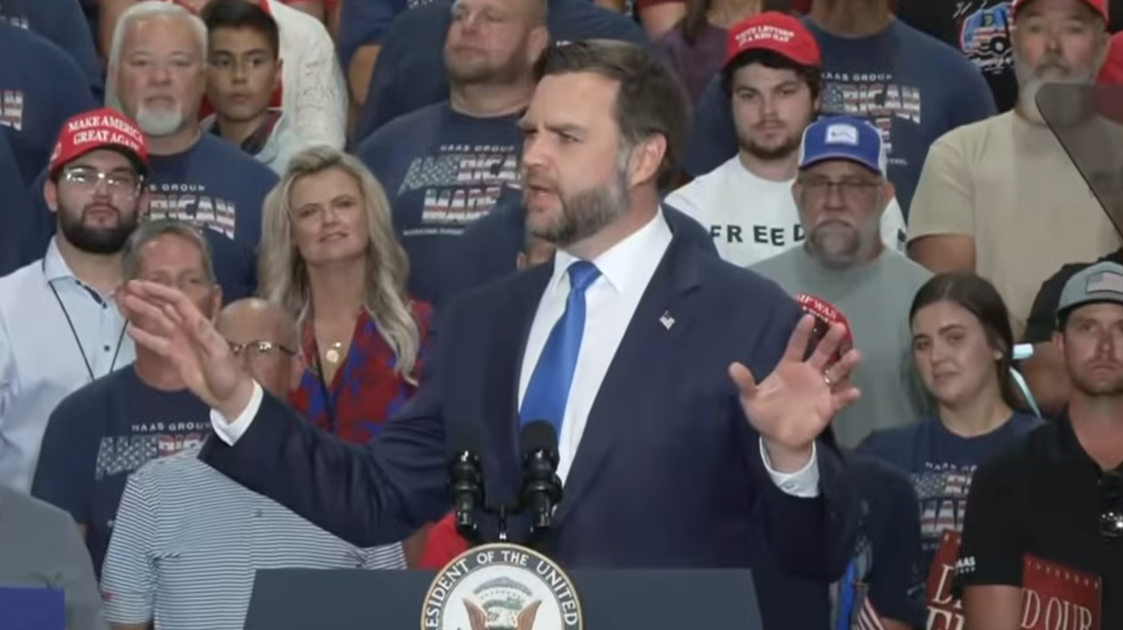
Vice President JD Vance spent two campaign stops this week testing a more combative rhetorical style, and the results suggested that his attempt to add edge to his public persona may need more work. During rallies in Montana and Kansas, demonstrators interrupted his remarks, prompting Vance to reach for insults and profanity. The response was notable less for its toughness than for its awkwardness: at one stop he dismissed protesters as “a few yahoos,” and at another he called a heckler a “bullshit artist” before immediately apologizing “for the kids.”
The contrast was stark. In Montana, Vance told the crowd that the protesters were a small disruption, using a folksy putdown that seemed designed to sound dismissive without escalating. Later in Topeka, Kansas, he tried a sharper approach. As he spoke about shared upbringing and Kansas values, a protester shouted, “You’re a war criminal!” The crowd drowned out the interruption with chants of “USA! USA!” Vance appeared frustrated, then used the moment to argue that Democrats cannot win a free and open debate.
Two rallies, two attempts at a tougher image
“The thing I’ve realized, having done these rallies for the last couple of weeks,” Vance said once the noise died down, “is that the only chance the Democrats have is to interrupt and shut down the debate because when we have a free and open debate, the American people will realize that all the Democrats are selling is a fat load of bullshit.” The line was clearly intended as a punchy, crowd-pleasing attack. It also marked a shift from the more careful language that has often defined Vance’s public appearances.
A second disruption came while Vance was discussing pee-wee football. Another protester began screaming, and Vance responded by calling the person “another bullshit artist.” He then added, “Excuse my language, for the kids,” before saying in a somewhat odd voice, “He’s out of here!” The sequence captured the central tension in Vance’s approach: he wants the edge of blunt language, but he also wants to be seen as responsible and family-friendly. The apology, however brief, undercut the toughness he was trying to project.
The authenticity problem
Vance has leaned on profanity more frequently at midterm election rallies, according to recent reporting, but the tactic has not consistently landed. Conservatives interviewed about the approach described a disconnect between the vice president’s words and his broader public image. One prominent conservative commentator, granted anonymity, argued that American politics has a deeper problem with politicians who believe cursing can manufacture authenticity. “There’s something deeper about American politics where people think you can fake authenticity by cursing,” the commentator said. “The thing about Trump cursing is — Trump normally curses. When he does, it’s because he talks like that.”
The commentator added that Vance seems to feel the need to signal his edge, “like a bad comedian,” and even imagined a self-aware aside: “like ‘Usha wouldn’t want me saying this.’” The comparison to Trump is unavoidable. Trump’s coarse language has long been read as an extension of his natural speaking style, whether critics find it appealing or not. Vance, by contrast, rose to national prominence as the author of “Hillbilly Elegy,” a memoir about family, class, and upward mobility, and as a Yale Law School graduate and former Marine. His public persona has often been more polished and deliberate. When he swears, the gesture can feel like a costume rather than a reflex.
A career built on reinvention
Vance’s political identity has already undergone a significant transformation. He first became known to a wide audience through his memoir, which was adapted into a film and made him a frequent commentator on working-class America. In 2022, he won a U.S. Senate seat in Ohio, and he later became vice president after a national campaign that showcased his willingness to attack opponents and defend the former president’s movement. His critics have long pointed to his past criticism of Trump, while his supporters say his evolution reflects a genuine reckoning with the Republican Party’s direction.
That history matters for the current moment. Vance is not simply a warm-up speaker at midterm rallies; he is a vice president with a national profile and an obvious stake in the future of his party. Vice presidents are often deployed to energize the base, raise money, and sharpen contrasts with the opposing party. A combative style can be useful in that role, especially when rallies are clipped for social media and when supporters reward politicians who seem willing to fight. But the same style can create vulnerabilities if it looks performative, if it distracts from the message, or if it hands opponents an easy argument that the vice president is more interested in insults than in substance.
Why swearing can work — and when it backfires
Maura Gillespie, a Republican communications strategist who previously worked for former House Speaker John Boehner, said swearing can make some politicians seem more relatable and can show passion. That is especially true when the language fits the speaker’s established personality. A candidate who already speaks bluntly may gain credibility by refusing to sanitize every sentence. A candidate who usually speaks in carefully constructed paragraphs faces a different test. If the profanity comes across as an act, Gillespie said, there can be consequences.
“My concern then becomes in the way that it does feel very scripted for some members that do it, it’s because it comes across as inauthentic, and it actually ends up backfiring,” she said. That warning applies directly to Vance’s recent rally appearances. The line about Democrats selling “a fat load of bullshit” may energize a friendly crowd, but the immediate apology for language “for the kids” signals discomfort with the very edge he is trying to display. The result is not a clean contrast between a plainspoken leader and delicate opponents. It is a politician trying on a style in public and occasionally checking whether the fit looks right.
The theater of heckler responses
Hecklers have become a familiar part of modern campaign rallies. They can disrupt a speech, but they can also give a speaker a ready-made foil. A crowd that chants over a protester is participating in the performance, and a candidate who responds with a memorable line can turn an interruption into a viral moment. The risk is that the response becomes the story. In Vance’s case, the “war criminal” shout and the “USA” chant were quickly followed by his profanity-laced answer, which drew more attention than the policy argument he was trying to make.
The Montana and Kansas stops also illustrated how quickly a rally can move from serious political messaging to odd juxtaposition. In one breath, Vance was talking about shared upbringing and the value of free debate; in another, he was discussing pee-wee football and calling a screaming protester a “bullshit artist.” That tonal shift can make the profanity feel less like a principled refusal to be polite and more like a rhetorical reflex. For a vice president still introducing himself to a broader electorate, the stakes are higher than they would be for a candidate in a safe seat.
The midterm backdrop
The midterms will shape the political landscape for both parties, and Vance’s role as a surrogate gives him a platform to test messages that could carry into future campaigns. His rallies are aimed at Republican crowds that expect energy and contrast. But general-election politics often rewards candidates who can appeal beyond the most committed supporters. If Vance’s cursing plays well only with the already converted, it may do little to expand his coalition. If it reinforces an image of calculation, it could complicate his efforts to present himself as a plainspoken champion of working-class voters.
The conservative criticism is telling because it comes from within the broader movement Vance is trying to court. The complaint is not that profanity is always disqualifying. It is that profanity ought to seem organic. Trump’s language, for better or worse, is widely understood as part of his long-established persona. Vance’s language is still being workshopped on the rally stage, and the seams show. His occasional apologies, his shifts in tone, and his attempts to play both the tough guy and the responsible adult create a muddled impression.
For now, the vice president appears determined to keep testing the approach. The rallies offered a clear view of the strategy and its limits: cheers from the crowd, a few sharp lines, and then a retreat into politeness. The question is whether repetition will make the style feel natural or whether it will continue to look like a politician reading lines that were written for someone else. Gillespie’s warning remains the most concrete measure of the risk. If the swearing is perceived as scripted, she said, it can backfire. Vance’s latest stops gave his critics fresh evidence for that concern.
Source:HuffPost News