

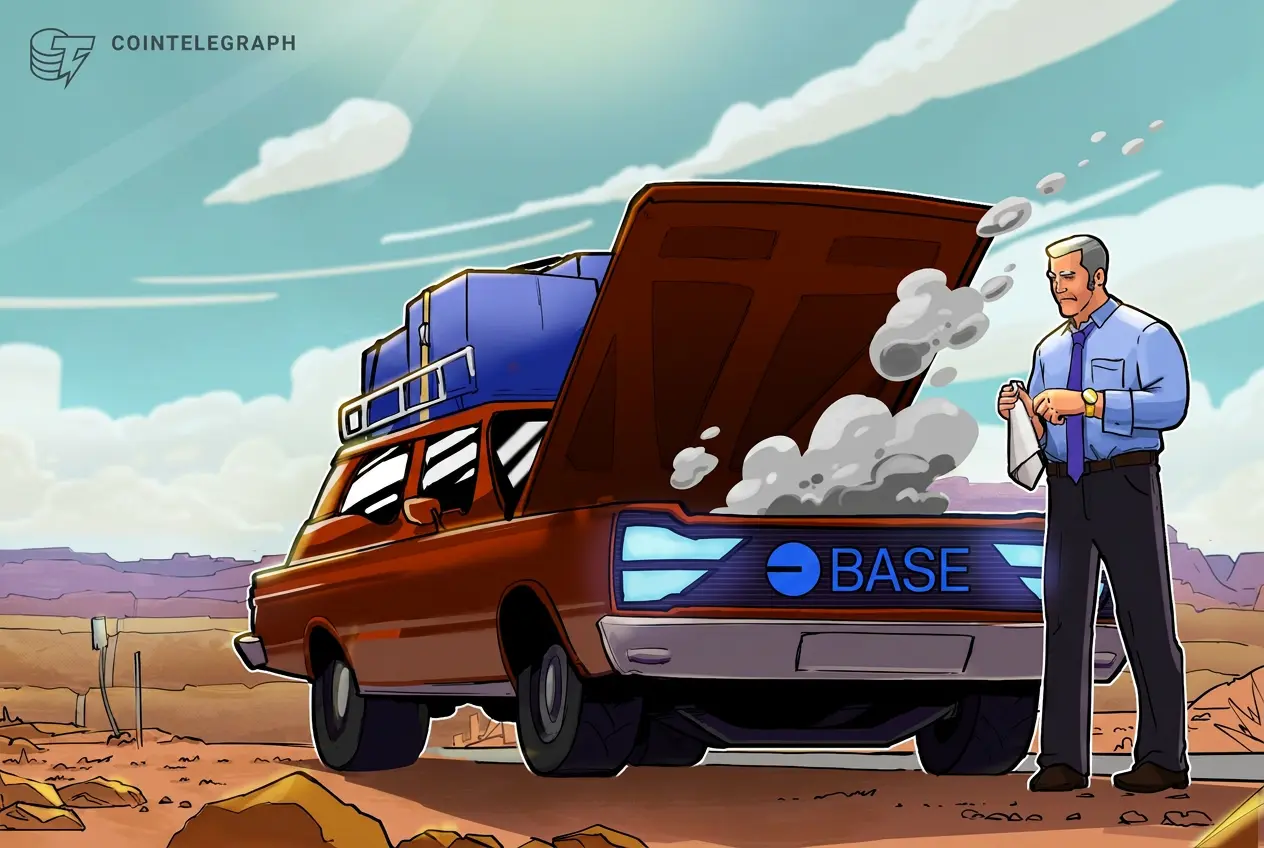
Coinbase's layer-2 blockchain, Base, experienced a notable interruption on Thursday when a consensus problem knocked the network offline for approximately two hours. The incident, which disrupted block production, was resolved by the team, and normal operations resumed by late afternoon UTC. The outage underscores the challenges facing even the most prominent blockchain networks as they strive for reliability and 24/7 availability.
What Happened During the Outage?
At 4:03 pm UTC on Thursday, Base's status page flagged that block production was "unhealthy." The team quickly began investigating the issue. By 5:21 pm UTC, they confirmed the root cause: a consensus problem had led to an invalid block being sequenced, which prevented new blocks from being created. This halted all transactions and activities on the network for nearly two hours.
Base posted an update at approximately 6:00 pm UTC stating that "healthy blockbuilding" had been recovered. The team verified that ecosystem-wide infrastructure was able to sync, and they reassured users that all funds on the network remained safe. A full post-mortem investigation is planned to identify the exact cause and implement fixes to prevent recurrence.
Context: Base's Role and Previous Downtime
Base is an Ethereum layer-2 blockchain developed by Coinbase, one of the largest cryptocurrency exchanges in the world. Launched in August 2023, Base quickly became the most used Ethereum layer-2 network by transaction volume and total value locked, largely due to its integration with Coinbase's vast user base and its low fees relative to Ethereum mainnet. The network uses a sequencer model to process transactions before submitting them to Ethereum for finality. This design, while efficient, introduces a single point of failure—the sequencer—which has been at the center of previous outages.
Thursday's outage is not the first for Base. In August 2025, the network went down for 33 minutes due to a similar sequencer issue. At that time, the team attributed the problem to a bug in the sequencer software. The latest incident, though longer in duration, was also linked to a consensus problem, suggesting that the network's architecture may still be vulnerable to certain failure modes. Other major blockchains, such as Solana and Sui, have also experienced periodic outages, highlighting the difficulty of maintaining continuous uptime in decentralized systems.
The Beryl Upgrade and Its Timing
The outage occurred just hours before Base was scheduled to deploy a major upgrade called "Beryl." The upgrade, set for 6 pm UTC on the same day, aimed to reduce delays on withdrawals and introduce a new token standard for real-world assets and stablecoins. The upgrade was designed to enhance Base's functionality and appeal to institutional users. While the team confirmed that the outage was unrelated to the upgrade, the timing raised questions about network stability ahead of critical updates. Beryl eventually proceeded as planned after the network recovered, though the incident may temper enthusiasm for rapid feature releases.
Broader Implications for Layer-2 Reliability
The outage on Base comes at a time when Ethereum layer-2 networks are increasingly handling a significant share of on-chain activity. According to data from L2Beat, Base alone processes over $2 billion in weekly transaction volume. For users and developers relying on these networks for decentralized finance, gaming, and other applications, even short outages can lead to missed opportunities, failed trades, and eroded trust.
The problem is not unique to Base. In May 2026, Sui, a layer-1 blockchain, experienced two separate periods of downtime on consecutive days. Sui later explained that the outages were caused by a network update that had a known low probability of causing a halt. Similarly, Solana has suffered multiple major outages since its launch, often attributed to network congestion or validator coordination failures. For Base, the recurrence of consensus-related issues suggests that more robust testing and redundant mechanisms may be needed to ensure high availability.
Response from Coinbase and the Community
Base creator Jesse Pollack addressed the community on X, stating that all funds on the network were safe but emphasized that "a halt is not okay." He committed to using the incident to "continue to level up base as a platform for global, 24/7 finance." The sentiment reflects the high standards expected of a network backed by a publicly traded company like Coinbase. The exchange itself has been expanding its services beyond crypto, recently allowing users to transfer stock portfolios, and Base is a key part of its blockchain strategy.
Community reactions were mixed. Some users expressed frustration over the disruption, while others praised the team's transparency and swift recovery. The incident also sparked discussions about the trade-offs between centralized sequencers and decentralized alternatives. Some projects, like Arbitrum and Optimism, have moved toward decentralized sequencers to reduce the risk of single points of failure. Base has yet to announce plans for sequencer decentralization, but the repeated outages may accelerate such discussions.
Technical Analysis: Consensus Problems and Block Production
To understand the outage, it helps to review how Base's sequencer works. The sequencer is a single entity that orders transactions and compresses them into blocks before submitting them to Ethereum. This model allows for fast and cheap transactions, but if the sequencer produces an invalid block—for example, one that violates consensus rules—the network can stall. In Thursday's case, an invalid block was sequenced, causing a chain split or a halt in block production. The team had to manually intervene to resolve the issue, presumably by discarding the invalid block and restarting the sequencing process.
The root cause of the invalid block is still under investigation, but possible factors include a race condition in the software, a bug in a recent update, or a misconfiguration. The post-mortem report, expected in the coming days, will provide more clarity. In the meantime, the event serves as a reminder that even well-funded and professionally managed blockchain networks can experience technical failures. For users, it reinforces the importance of diversifying across multiple chains and preparing for the possibility of downtime.
From a security perspective, all funds on Base were safe because the underlying state was preserved on Ethereum mainnet. The layer-2's data availability ensures that even if the sequencer fails, users can retrieve their assets by submitting forced transactions to the Ethereum network. This design feature is standard among layer-2 solutions and provides a safety net, but it does not prevent the inconvenience of a halted network.
Historical Context: Blockchain Outages as a Systemic Challenge
Blockchain outages have been a recurring theme in the industry. In 2021, Solana experienced a 17-hour outage due to a denial-of-service attack. In 2022, Algorand faced a temporary halt due to a consensus bug. And just last year, the Ethereum layer-2 network Optimism suffered a brief outage after a node sync issue. These incidents highlight that while blockchains are designed to be resilient, they are not immune to software bugs, network attacks, or human error.
For Base, the two-hour outage is relatively minor compared to longer downtimes seen on other chains, but it is significant given Base's prominence and the expectations set by its parent company. Coinbase has positioned Base as a foundational layer for the on-chain economy, with integrations across DeFi, NFTs, and real-world assets. Any disruption undermines that vision and gives competitors an opportunity to highlight their own reliability.
The industry is watching closely to see how Base responds. A thorough post-mortem that leads to concrete improvements—such as enhanced testing, redundant sequencers, or automated recovery mechanisms—could restore confidence. Conversely, repeated failures could drive users to alternative layer-2 networks like Arbitrum, Optimism, or zkSync, which have maintained more consistent uptime.
Looking Ahead: What This Means for Base and Layer-2s
Despite the outage, Base continues to be a powerful player in the layer-2 ecosystem. The Beryl upgrade, which went live after the network recovered, brings new features that could attract more institutional users and stablecoin issuers. The new token standard for real-world assets, in particular, aligns with the trend of tokenizing traditional financial instruments on-chain. However, the reliability of the underlying infrastructure will be a key factor in whether these ambitions are realized.
For now, the Base team has restored normal operations and is committed to transparency. The incident serves as a reminder that even the most advanced blockchains are works in progress. As the industry matures, the expectation for 24/7 uptime will only grow, and networks that cannot meet that standard will likely face user attrition. The next few months will be critical for Base as it works to build a reputation for reliability while rolling out new features and expanding its ecosystem.
Source:Cointelegraph News