

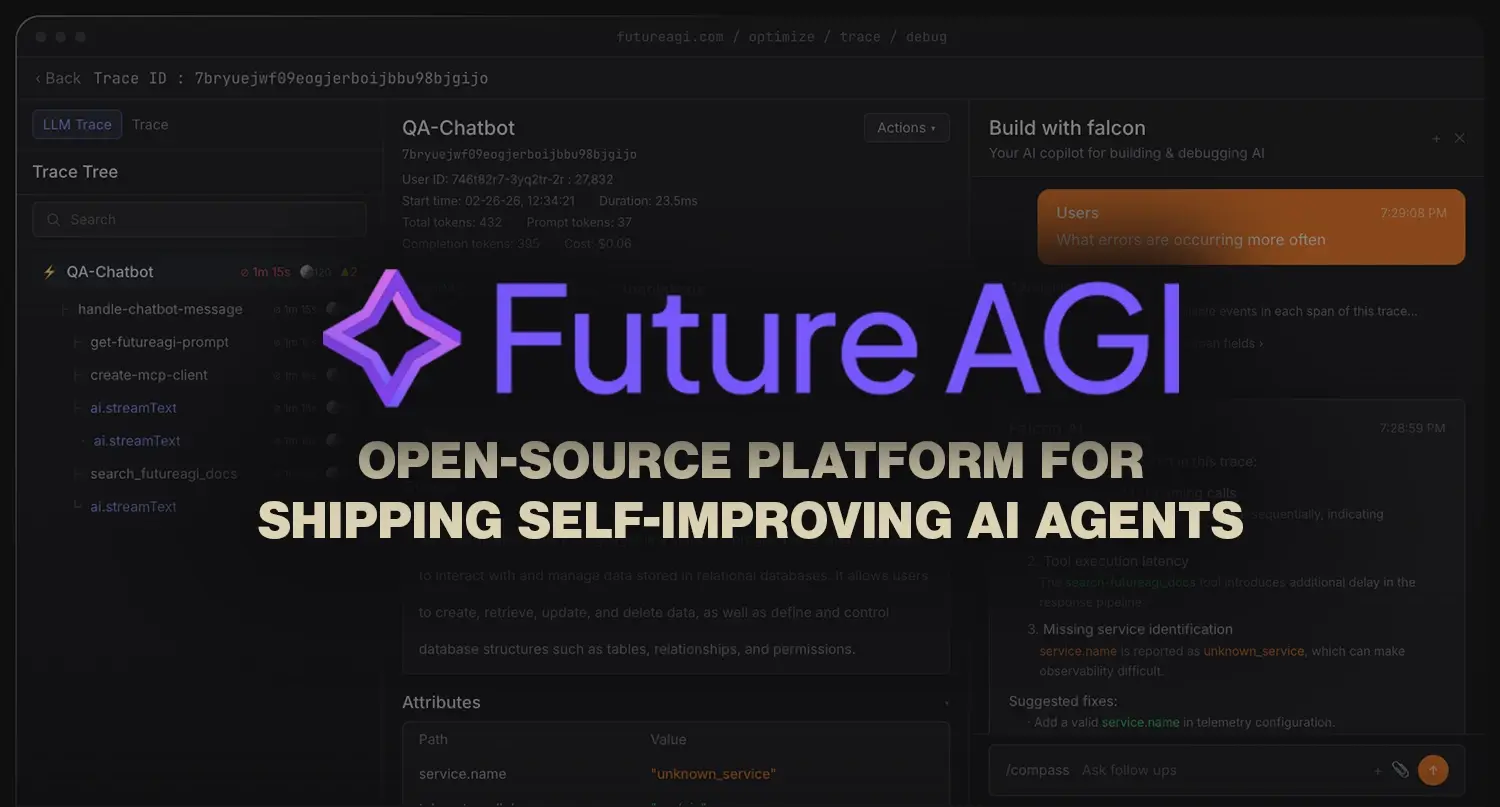
Future AGI enters the crowded AI agent tooling space with an ambitious promise: a single, open-source control plane for tracing, evaluating, simulating, and guardrailing self-improving agents. The platform is now generally available under Apache 2.0, and operators can self-host the entire stack on their own infrastructure. That makes it a potentially attractive option for teams that want to move quickly with agentic systems without routing every trace through a managed cloud service.
Key facts at a glance
- Future AGI is open-source under Apache 2.0 and fully self-hostable.
- The platform installs with ClickHouse, PostgreSQL, Redis, RabbitMQ, and Temporal behind a dashboard on localhost:3000.
- First boot sends a one-time registration containing instance ID, version, deployment type, and the email addresses/domains of active admins.
- Telemetry can be disabled with FUTURE_AGI_TELEMETRY_DISABLED=1 before first start; air-gapped deployment is supported.
- Instrumentation uses OpenTelemetry and covers more than 50 agent frameworks.
- The Agent Command Center is an OpenAI-compatible proxy for 100+ providers with routing, caching, virtual keys, MCP, and A2A.
- Protect includes 18 built-in scanners and vendor adapters for Lakera, Presidio, and Llama Guard.
The telemetry trade-off
The most important operational detail of Future AGI may be what happens the first time the server starts. Self-hosted instances register with the project's telemetry service on initial boot. That registration is not a choice presented in a setup wizard; it is a one-time network call that sends a few identifiers to the vendor. The payload includes an instance ID, a version string, a deployment type, and the email addresses and domains of active admin users. Because this happens before anyone signs in to the dashboard, an operator who has already configured admin accounts cannot stop the initial notification by changing settings later.
The only way to avoid the call entirely is to set the environment variable FUTURE_AGI_TELEMETRY_DISABLED=1 in .env ahead of the first start. If the window is missed, the admin list has already left the network. After telemetry is disabled, the system sends a single census ping containing instance ID, version, and deployment type, with email withheld, and periodic heartbeats stop. The documentation also suggests turning networking off at the edge for full silence.
For security teams, this is an important nuance. Air-gapped and on-prem installations are described as supported and phone-home free, but phone-home free depends on taking the documented step before boot. In a deployment that cannot tolerate outbound calls, an operator should treat the first boot as a network boundary event and either block egress at the firewall or run the platform inside a sandboxed environment.
Inside the self-hosted stack
Future AGI is not a simple single-binary application. The installer brings up a mature backend consisting of ClickHouse for columnar storage, PostgreSQL for relational metadata, Redis for caching and queues, RabbitMQ for message brokering, and Temporal for durable workflow execution. All of these run behind a dashboard on localhost:3000. The choice of Temporal in particular signals that the platform is designed for long-running, event-driven agent workflows, not just one-shot LLM calls.
Spans and trace data land in ClickHouse. Prompt text, model output, and tool calls all pass through the tracer on the way into that store. Because ClickHouse is a high-performance analytical database, operators can query large volumes of agent activity over long time windows without rebuilding a separate observability pipeline. The data store is also where the security component called Defender inherits its access controls: if a team already manages permissions on the database, the same boundary applies to traces.
Tracing and instrumentation across frameworks
Instrumentation covers more than 50 agent frameworks, including LangChain, LlamaIndex, CrewAI, and DSPy, through OpenTelemetry. OpenTelemetry has become the de facto standard for cloud-native observability, so integration with that ecosystem means teams can pair Future AGI with existing Grafana, Prometheus, or Jaeger deployments if needed. The breadth of frameworks is important because agentic applications often mix toolkits in a single workflow. A LangChain orchestration layer might call a DSPy-optimized model, while CrewAI workers share context and state. Without cross-framework instrumentation, tracing these interactions is painful.
For teams building custom agents, the SDK approach means instrumentation is not limited to supported frameworks. The tracer can be added to any Python or TypeScript code path, allowing a unified view of both framework-managed agents and bespoke logic.
A gateway built for agent governance
The Agent Command Center sits in front of everything. It is an OpenAI-compatible proxy that fronts more than 100 providers, which means companies can keep a single API endpoint for their applications while changing model providers without rewriting code. The proxy includes routing strategies, semantic caching, virtual keys, Model Context Protocol (MCP), and Agent2Agent (A2A) support. Virtual keys let administrators issue scoped credentials to different teams or services while keeping the underlying provider account secret. Every provider credential in a deployment terminates at the gateway, which creates a natural choke point for policy enforcement.
Routing strategies allow the platform to send requests to different models based on cost, latency, or task complexity. Semantic caching reduces repeated calls by recognizing similar prompts and returning the cached response when appropriate. MCP support gives agents access to external tools through a standardized protocol, while A2A allows agents from different frameworks to communicate. For organizations with many internal use cases, this centralization makes auditing and cost allocation much easier.
Security scanning and guardrails
Protect is the security layer of Future AGI. It ships with 18 built-in scanners covering PII, jailbreak attempts, and prompt injection. In addition, vendor adapters are available for Lakera, Presidio, and Llama Guard. Scanners can run inline in the gateway or standalone through the SDK. Inline scanning is optimized for latency: the project's benchmark harness reports P99 latency at or under 21 milliseconds on the guardrail path.
Prompt injection remains one of the most difficult problems in agentic AI. An attacker can encode malicious instructions in web pages, email text, or tool outputs that an agent later reads. A defense-in-depth approach is necessary, combining input-side scanning with output-side validation. Future AGI's scanner lineup is designed for both: PII detection keeps sensitive data from being sent to external models, jailbreak detection blocks adversarial prompts, and prompt-injection scanners catch instructions smuggled into unrelated content. The gateway placement matters because it allows these checks to be enforced consistently across every provider and every application using the platform.
Why self-improving agents need a control plane
The launch of Future AGI comes at a time when enterprise interest in agentic AI is growing rapidly. Self-improving agents promise to automate complex workflows, such as writing code, navigating APIs, or managing support tickets, but they also introduce new risks. An agent with broad tool access can read files, send messages, or trigger cloud deployments. If a prompt injection turns one agent into an attacker's pawn, the potential damage is much greater than a single model hallucination.
Self-improving agents use feedback loops to refine prompts, tools, and outputs over time. That creates a growing need for tracing and evaluation, because an agent that changes its own behavior can drift unexpectedly. A trace that captures every input, tool call, and model output gives engineers a way to understand why an agent made a particular decision. Without this visibility, debugging becomes nearly impossible once a workflow has branched across multiple models and tools.
Open-source platforms have become a critical part of this landscape. They give security teams the ability to inspect code, run hardening controls, and keep data in-house. Future AGI's Apache 2.0 license allows commercial use, modification, and redistribution without the restrictions of some other open-source licenses. The availability of vendor adapters and a large framework list suggests the project is targeting serious production deployments rather than simple experimentation.
Still, the telemetry behavior is a reminder that open source and privacy are not automatically the same thing. The project discloses the first-boot call clearly and offers an opt-out, but the opt-out has a strict time limit. Operators who are evaluating the platform for long-term internal use should test the telemetry behavior in a disposable environment first, then deploy with the environment variable set and network policies enforced. Future AGI is freely available on GitHub, and the project includes deployment guides for Docker Compose, Kubernetes, and air-gapped environments.
Source:Help Net Security News