

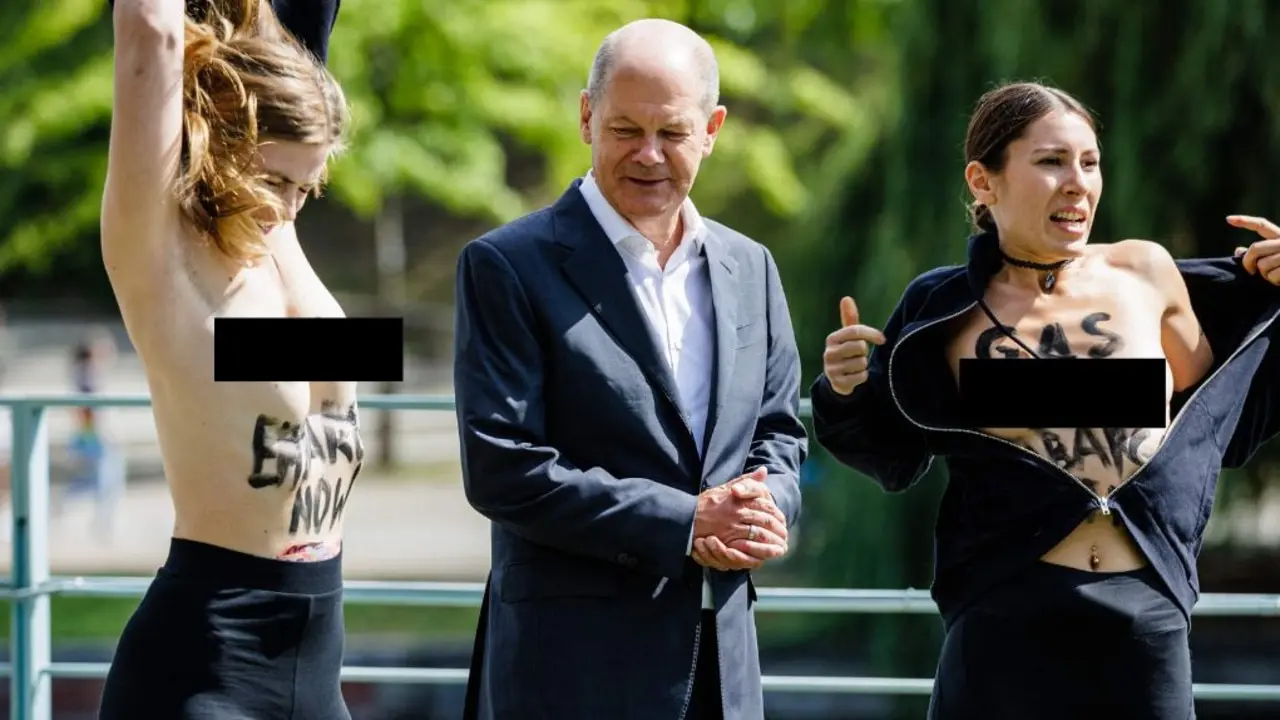
German Chancellor Olaf Scholz found himself at the center of an unexpected protest on Sunday when two women removed their tops during a photo opportunity and revealed political slogans painted on their chests. The incident took place during the German government’s annual open house weekend, a tradition that allows citizens to meet their leaders and explore the federal chancellery.
The two protesters initially appeared to be ordinary visitors hoping for a selfie with the chancellor. According to eyewitness accounts, they approached Scholz together and were allowed to pose beside him for a photograph. Moments later, they pulled off their jerseys, exposing painted messages that demanded a “gas embargo now” against Russia. The slogan appeared to be a direct appeal to the German government to halt all imports of Russian natural gas in response to Moscow's ongoing invasion of Ukraine.
Security officials reacted quickly, surrounding the women and escorting them away from the event. The brief confrontation was captured by photographers and quickly circulated on social media, where it drew renewed attention to Germany’s fraught energy policy and its delicate position in the broader European response to the war in Ukraine.
Topless protest and Femen's involvement
The protest bore the hallmarks of Femen, the Ukraine-origin feminist activist group known for theatrical topless demonstrations. Femen activists have long used bare-chested protests to draw maximum media attention to political causes, and the group has repeatedly targeted high-profile leaders and institutions. A photograph from the scene showed one woman being arrested by security personnel while visibly wearing slogans related to the proposed embargo. The image was widely shared online and reinforced the group’s signature style of direct, body-based political protest.
The open house weekend is supposed to be a relaxed occasion for the public to engage with their elected officials, but it has increasingly become a venue for acts of political theater. Scholz, a veteran politician of the Social Democratic Party (SPD), is no stranger to public confrontation. However, the unexpected nature of the protest left him visibly surprised, with photographs showing him looking sideways as the women stripped off their garments during the photo-op.
Germany’s difficult relationship with Russian gas
Germany’s energy relationship with Russia has been one of the most debated topics in European politics since the beginning of the full-scale war in Ukraine in February 2022. For decades, Germany relied heavily on imported Russian natural gas to power its industries, heat homes, and generate electricity. This reliance was built through long-term supply contracts, direct pipeline connections, and cooperative energy policies that dated back to the Cold War era.
By the time Russia invaded Ukraine, Germany was among the largest purchasers of Russian energy in Europe. That dependency created a geopolitical dilemma when Western countries moved to punish the Kremlin with economic sanctions. While many NATO and European Union member states pushed for an immediate embargo on Russian energy exports, Germany resisted a full ban, arguing that it would cause severe economic damage and threaten the country’s social stability.
The German government’s stance drew criticism from Ukraine and from within Germany itself. Some political parties, NGOs, and protest movements argued that continued purchases of Russian gas effectively financed the war machine of President Vladimir Putin. Others pointed out that a sudden halt to supply could trigger factory shutdowns, job losses, and a major energy crisis in Europe’s largest economy.
At the same time, Moscow began cutting gas deliveries to Germany and other European countries, using energy as a geopolitical weapon. The reduction of flows through the Nord Stream pipeline network and other routes forced Berlin to accelerate its search for alternative energy sources. The open house weekend protest took place against this tense backdrop, making the two women’s shocking photo-op a powerful symbolic moment.
Scholz’s defense of government energy strategy
Earlier on Sunday, before the protest, Scholz had answered questions from the public and tried to defend the government’s record on energy security. He acknowledged the challenges posed by the reduction in Russian gas supplies and outlined a range of measures Berlin was taking to diversify its energy imports. Chief among these was the construction of new liquefied natural gas (LNG) terminals, which would allow Germany to receive gas shipped by tanker from countries such as Qatar, the United States, and elsewhere.
Scholz expressed hope that the first LNG terminals would be operational by early next year. He further stated that once those facilities were online, Germany’s supply security problem could be solved “at the beginning of 2024.” These comments underscored the scale of the task facing the German government, as building LNG infrastructure typically takes years of planning and construction, but Berlin has plunged ahead with accelerated procedures in response to the emergency.
The chancellor’s cautious language reflected a broader concern among European officials about the coming winter. With Russia throttling gas supplies to Europe, Germany was bracing for potential power shortages, higher heating bills, and industrial disruption. The government launched public campaigns urging citizens to save energy and instituted measures to fill gas storage facilities before the cold months arrived. Yet despite these actions, the risk of scarcity remained real, and public anxiety continued to rise.
The growing demand for a gas embargo
The protest at the open house event was not an isolated occurrence. Since the start of the war, a loose coalition of activists, opposition politicians, and civic groups had staged numerous demonstrations calling for a complete halt to Russian energy imports. Some argued that moral responsibility outweighed economic risk, insisting that Western nations should not continue enriching the Kremlin while Ukraine suffered daily missile attacks and civilian casualties.
Advocates of a gas embargo pointed to reports that Russian energy revenues were helping to fund the war effort. They argued that Germany, despite its extensive dependence, could have done more to prepare for a hard cutoff. Supporters of the embargo also highlighted potential solidarity mechanisms within the European Union, where member states could share existing LNG supplies and coordinate reductions in consumption.
On the other side of the debate, many economists and industrial leaders warned that a rapid embargo would send shockwaves throughout the German economy. The country’s export-oriented manufacturing sector, which relies on affordable energy, would face severe competitive disadvantages. A sudden halt in gas deliveries could also trigger a cascade of bankruptcies in energy-intensive sectors such as chemicals, steel, and glassmaking. The German government repeatedly emphasized this economic vulnerability when resisting calls for an immediate ban.
Sunday’s topless protest, while brief, highlighted the tension between these two positions. By choosing the high-profile setting of a photograph with the chancellor, the activists guaranteed maximum attention for their demand. Their action demonstrated that even in a symbolic meeting between citizens and their leader, the issue of Russian energy remained inescapable.
Energy security and the road ahead
In the months that followed the incident, Germany continued to take steps to reduce its reliance on Russian gas. The government temporarily reactivated coal-fired power plants, extended the lifespan of some nuclear facilities, and fast-tracked renewable energy projects. LNG import terminals appeared in northern German ports with unprecedented speed, while floating storage units were leased to bring new gas capacities online faster than had been thought possible.
By the time winter arrived, Germany had managed to fill its gas storage facilities above target levels, partly due to relatively warm weather and aggressive conservation measures. Still, the energy crisis caused electricity prices to soar and forced many households to face painful heating costs. The geopolitical and economic consequences of the war continued to shape German politics, with debates over sanctions, military aid to Ukraine, and energy policy dominating the public agenda.
The image of Scholz standing next to the topless protesters became one of many memorable moments in a turbulent period of German history. It illustrated the depth of passion surrounding the question of Russian gas and the willingness of activists to go to extraordinary lengths to make their voices heard. It also served as a reminder that energy policy is never just a technical matter; it is a political battlefield where values, security, and economic interests collide.
For Scholz, the incident was a brief but telling interruption in a day otherwise devoted to ceremonial openness. But the underlying issue that motivated the two protesters remained unresolved. Germany’s transition away from Russian energy continued to unfold gradually, shaped by bureaucratic procedures, infrastructure projects, public pressure, and the shifting realities of war and diplomacy on the European continent.
Source:news.com.au News