

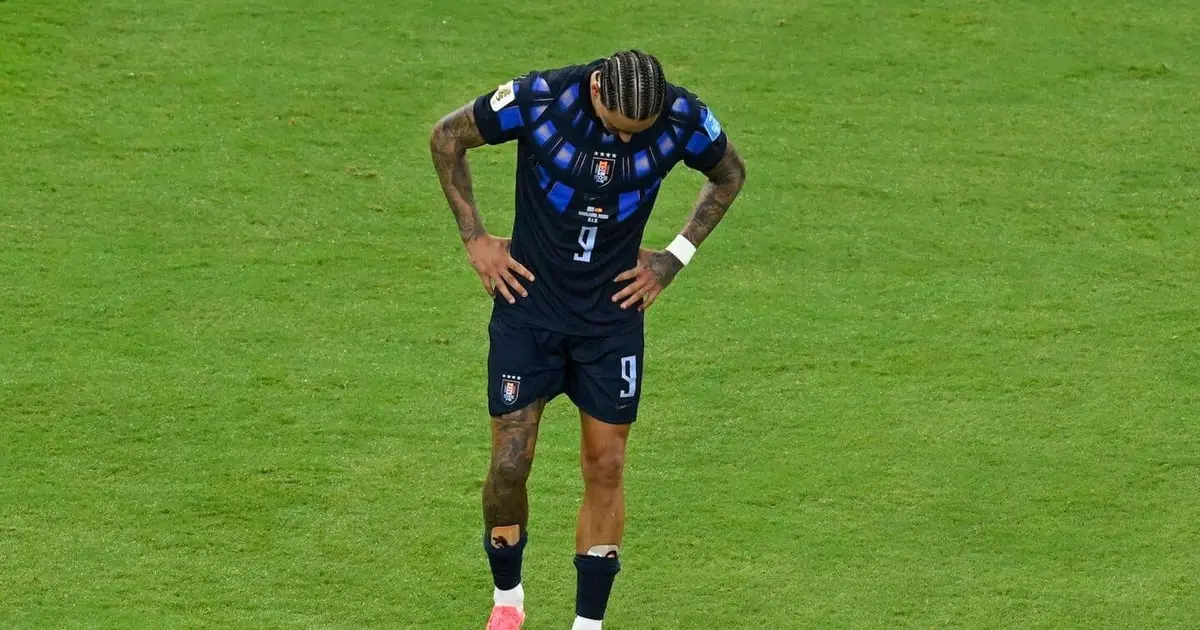
Uruguay's 2026 World Cup journey came to a premature end on Saturday night as they fell to a 1-0 defeat against Spain in Guadalajara. The result condemned Marcelo Bielsa's side to an early exit, with only two points from three matches in a group that many expected them to navigate with relative ease.
The decisive moment arrived in the 42nd minute when Álex Baena's speculative shot from outside the area squirmed under the grasp of Uruguay goalkeeper Fernando Muslera. It was a catastrophic error from the veteran shot-stopper, who had been a reliable figure for his country for over a decade but whose tournament was marred by uncharacteristic mistakes. Bielsa's decision to substitute Muslera at half-time – reportedly at the goalkeeper's own request – underscored the gravity of the blunder.
Uruguay pushed for an equalizer in the second half but lacked the cutting edge that has defined their best teams. Darwin Núñez, Federico Valverde, and Rodrigo Bentancur, all stars at top European clubs, failed to combine effectively against a disciplined Spanish defense. Spain, meanwhile, controlled possession and created the better chances, with Ferran Torres hitting the crossbar late on. The match ended in frustration for Uruguay, with substitute Agustín Canobbio receiving a red card in stoppage time for a dangerous challenge.
A group that promised much but delivered little
When the draw for Group H was made, Uruguay were widely expected to progress alongside Spain. Cape Verde and Saudi Arabia were perceived as underdogs, but the two-time world champions stumbled from the outset. A 1-1 draw with Cape Verde in their opening match was a warning sign, followed by another stalemate against Saudi Arabia. Those two dropped points proved fatal.
Uruguay's failure to beat Saudi Arabia was particularly damaging. The Saudi side, coached by Roberto Mancini, defended resolutely and held on for a 0-0 draw. Uruguay's lack of creativity against low blocks was exposed, a problem that had plagued Bielsa's tenure. Despite having talented individuals, the team rarely clicked in attack. The 1-0 loss to Spain merely confirmed the inevitable: Uruguay would not be part of the round of 32.
Bielsa's future in doubt
After the match, Marcelo Bielsa offered a stark assessment of his own performance. 'I failed to get the best out of the players at my disposal,' he admitted. 'The responsibility is mine.' The 70-year-old Argentine is now expected to step down, bringing an end to a turbulent reign that began in 2023. Bielsa's contract runs through 2027, but the early World Cup exit may accelerate negotiations over his departure.
Bielsa has a mixed record at World Cups. He took Argentina to the group stage exit in 2002, led Chile to the round of 16 in 2010, and now departs at the first hurdle with Uruguay. His high-intensity style, successful in parts, never fully adapted to the international break calendar, and the team often looked fatigued in key moments.
Spain's quiet efficiency
For Spain, the victory secured top spot in Group H with seven points. Luis de la Fuente's side opened with a goalless draw against Cape Verde before thrashing Saudi Arabia 3-0. The win over Uruguay was workmanlike rather than brilliant, but the defense has been impeccable – three clean sheets in three matches. Only Mexico have matched that record so far in the tournament.
The draw opens up favorably for Spain, who will face either Austria or Algeria in the round of 32 in Los Angeles. De la Fuente has depth in his squad, with Dani Olmo, Fabián Ruiz, Nico Williams, and Ferran Torres all making impactful appearances from the bench. The main concern remains a lack of ruthlessness in front of goal – Spain dominated possession against Uruguay but scored only once, a pattern that can be punished in knockout football.
Lamine Yamal, the teenage sensation, showed flashes of brilliance but is still returning to full fitness after a minor injury. When he hits top gear, Spain's attack could become truly formidable. Player of the match honors went to Marcos Llorente, whose tireless running and intelligent passing underpinned Spain's control of the game.
Uruguay's generation at a crossroads
The elimination raises uncomfortable questions about Uruguay's golden generation. Valverde, Araujo, Núñez, and Bentancur are all in their prime years, yet they have failed to make a significant impact at a World Cup. The post-Luis Suárez era has seen a decline in goal production, with Uruguay scoring just two goals in three group matches – both against Cape Verde. The attack looked toothless when it mattered most.
Jack Lang, a football writer covering the tournament, noted: 'Uruguay have always been world football's great overachievers relative to the size of the country's population. They've been knocked out by a country that has half a million citizens [Cape Verde].' That Cape Verde, a tiny island nation, advanced to the knockout rounds while Uruguay stayed home is a painful irony. Cape Verde drew with Saudi Arabia to secure second place and set up a round-of-32 meeting with Argentina.
The talent in Uruguay's squad is undeniable. Valverde is a Champions League winner with Real Madrid, Araujo a defensive stalwart at Barcelona, Núñez a prolific scorer for Liverpool. Yet Bielsa's system never seemed to harness their collective abilities. The team lacked structure in possession and mental resilience when faced with adversity. A reset beckons, and with it some uncomfortable conversations in Montevideo about the direction of the national team program.
What comes next for Spain
Spain now turn their attention to a knockout stage that looks increasingly manageable. With defending champions Argentina on the other side of the bracket, and traditional powers like Brazil and France still finding their rhythm, La Roja have a genuine opportunity. The defense, marshaled by Rodri and a solid back line, has conceded zero goals. The midfield controls games with typical Spanish poise. The final third just needs a sharper edge.
Luis de la Fuente's squad selection has been vindicated, with players like Álex Baena, who has had a difficult season at Atlético Madrid, stepping up. Baena's goal against Uruguay had added significance: three years ago, he was involved in a confrontation with Valverde that led to a court case. The incident left Baena considering quitting football. Scoring the goal that eliminated Valverde's Uruguay was a redemptive moment.
Spain's tournament experience is deep, with many players having won the 2023 Nations League. They know how to manage pressure and navigate tight matches. The only quibble is a lack of goals, but if Lamine Yamal finds his scoring boots, Spain could go all the way. For now, they are quietly efficient, and that might be enough.
Uruguay's tournament in numbers
- Matches played: 3 (W0 D2 L1)
- Goals scored: 2
- Goals conceded: 2
- Points: 2
- Group finish: 3rd
For context, Uruguay's 2022 World Cup campaign also ended in the group stage, with a win over Ghana not enough to advance. This time, they failed to win a single match. The defensive solidity that characterized Bielsa's early tenure evaporated, and the attack never clicked. The midfield, led by Valverde, worked hard but without the cutting edge needed to unlock stubborn defenses.
Marcelo Bielsa's position as head coach now looks untenable. The Uruguayan Football Association (AUF) will likely begin a search for a successor in the coming days. Names like Diego Simeone (if he leaves Atlético Madrid) and former Uruguay captain Diego Lugano have been mentioned. Whoever takes over will inherit a talented but underperforming squad with a limited window before the next World Cup cycle begins.
Uruguay's exit is also a story of what might have been. The team that finished third at the 2010 World Cup and reached the quarterfinals in 2018 seemed to have a bright future. But progressive decline – from quarterfinalist to group stage in 2022, and now to bottom-of-the-group in 2026 – suggests deeper structural issues. The youth development pipeline, once so productive, has not produced a reliable goal-scorer since Suárez and Cavani. Núñez is brilliant but inconsistent at international level. Bielsa's gamble on a high-risk style did not pay off, and the players looked lost when plan A failed.
As the final whistle blew in Guadalajara, Uruguay's players collapsed to the turf. Valverde, the captain, sat alone in the center circle, head in hands. The image captured a generation's despair. For Spain, it was a routine win. For Uruguay, it was the end of an era.
Cape Verde's achievement deserves recognition. Becoming the smallest nation to reach the World Cup knockout stages is remarkable. They defended as a unit, capitalized on set pieces, and showed remarkable composure. Their reward is a date with Lionel Messi's Argentina in the round of 32. It will be a challenge, but they have already made history.
The World Cup continues, but for Uruguay, the dream is over. The post-match discussion centered on Bielsa's future, Muslera's error, and the team's inability to rise to the occasion. The questions facing Uruguay are bigger than any one man. This is an excellent generation running short on tournaments to deliver something. The talent is undeniable; harnessing it is the part that keeps slipping away. A reset beckons, and with it some uncomfortable conversations in Montevideo.
Source:The Athletic News