

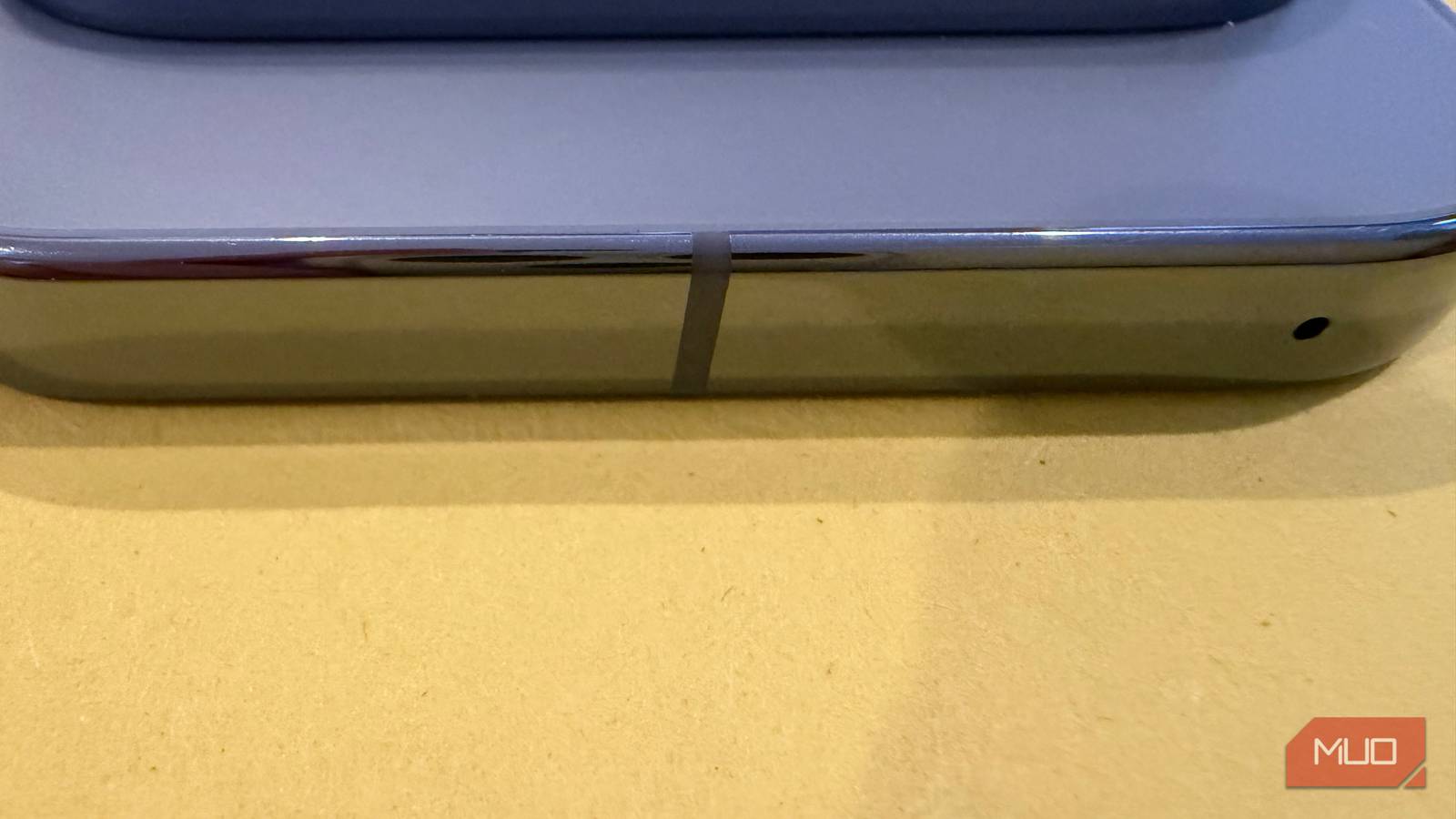
Have a close look at your phone. Chances are, it has random lines integrated into the frame, perhaps on the side rails or along the back. You might even notice an oval-shaped cutout that looks similar to a fingerprint scanner, but it's not. These lines and cutouts aren't there for aesthetics—frankly, they can be quite ugly. They exist to solve an engineering problem that every device maker has faced since phones moved to metal unibody construction.
What Are These Weird Lines and Cutouts on My Phone?
They're Not a Design Choice; They Are a Forced Compromise
Older phones, such as the iconic HTC One M7 from 2013, awkwardly placed these lines on the back of the phone as dividers between various components. Later, manufacturers figured out how to position these lines along the edges, allowing the back to be a clean, uninterrupted surface. This evolution is visible in devices like the Samsung Galaxy S22 and the iPhone Air, where the lines are neatly hidden along the sides.
The Problem: Metal Is the Enemy
Metal Blocks Wireless Signals
Before the switch to metal, most phones were made of plastic. Plastic was lightweight, durable, and crucially did not interfere with wireless signal transmission. In the early 2010s, phone manufacturers moved to metal unibody phones, often carved from a solid block of aluminum. This shift served multiple purposes. First, metal looked and felt premium. It reflected light beautifully and remained cool to the touch, giving devices a jewel-like precision versus the greasy, fingerprint-prone finish of plastic. Second, metal addressed heat dissipation. Heat is the enemy of small devices without active cooling (like a fan). Metal, especially aluminum, is an excellent conductor, allowing the entire phone to act as a heat sink, preventing processor throttling and battery drain. Third, metal offered structural rigidity and tighter tolerances. As phones grew larger and thinner, plastic couldn't keep up with the demands of industrial design. Precision CNC machines could carve a phone from a single piece of aerospace-grade aluminum, enabling impossibly thin side rails while maintaining high rigidity.
However, these metal phones presented a major engineering challenge: how would wireless signals—cellular, Bluetooth, Wi-Fi, GPS—escape the device? A metal phone is essentially a Faraday cage, an enclosure that blocks electromagnetic fields. This is a fundamental problem for a device designed to communicate wirelessly.
The Solution: Plastic/Composite Lines or Glass Windows
Manufacturers solved this by introducing gaps in the metal body. These gaps are filled with plastic or composite materials that allow radio waves to pass through. Alternatively, glass cutouts are used, as seen in the latest pro iPhones or in the "visor" on most Pixel devices. A secondary benefit of glass cutouts (or full glass backs that look like metal, common on Samsung phones) is that they enable wireless charging, which is impossible on a fully metal phone.
What About That New Large Oval on Phones?
That's Your mmWave 5G Antenna Cutout
On some devices, you might notice an oval cutout along the edge that resembles a fingerprint sensor. This is the mmWave 5G antenna cutout. It is designed for the ultra-rare, almost non-existent flavor of 5G that was supposed to bring gigabit-level speed and low latency. In reality, mmWave networks are rare (except in densely populated areas) and most users never connect to them because they are expensive, cover short distances, and consume significant battery. The lack of mmWave networks makes the standard antenna lines on your phone even more important, enabling low and mid-band 5G as well as 4G/LTE.
The Evolution of Antenna Design
Antenna placement has evolved significantly. Early metal phones like the HTC One M7 had large plastic bands across the back. Later designs moved these to the edges, often creating a seamless look. Modern phones use a "glass sandwich" design: glass front and back with a metal frame. This allows the metal frame to provide structural rigidity while the glass backs let signals pass through. Some devices, like the Google Pixel series, use a glass window on the back that also houses the camera module. Samsung's Galaxy series uses a metal frame with antenna lines hidden in the corners and along the top and bottom edges. The iPhone series uses a combination of glass and metal with tiny plastic strips along the frame.
These antenna lines are not just single lines; they are carefully tuned to specific frequencies. Engineers design them to resonate at multiple bands, ensuring good signal quality across different carriers and regions. The number and position of these lines vary by device, but they all serve the same purpose: to let signals out while maintaining the phone's structural integrity.
Wireless Charging and the Metal Problem
Wireless charging relies on inductive charging pads that use magnetic fields to transfer energy. Metal blocks these fields, so a fully metal-backed phone cannot charge wirelessly. This is a major reason why many flagship phones have switched to glass backs, even if the frame remains metal. Some manufacturers, like OnePlus and Xiaomi, have used ceramic backs, which allow wireless charging while feeling premium. However, ceramic is more brittle than metal and can shatter on impact. The glass sandwich design remains the most practical solution, balancing aesthetics, signal transparency, and durability.
Another factor is the increasing number of antennas in modern phones. With 5G, MIMO, Wi-Fi 6E, Bluetooth, NFC, and UWB, phone designers must fit multiple antennas into a tiny space. This is why you often see multiple lines or cutouts on a single phone. Engineers also face challenges with antenna isolation—preventing one antenna from interfering with another. Plastic dividers help create separate resonant chambers for each antenna, reducing interference.
In summary, those lines and cutouts are not accidental or merely decorative. They are a critical part of your phone's wireless system, solving the fundamental problem of transmitting signals through a metal body. Every phone maker must address this challenge, and the solutions have become a defining feature of modern industrial design. So, next time you see those lines, you'll know they represent a clever engineering compromise that keeps your phone connected and functional.
Source:MakeUseOf News