

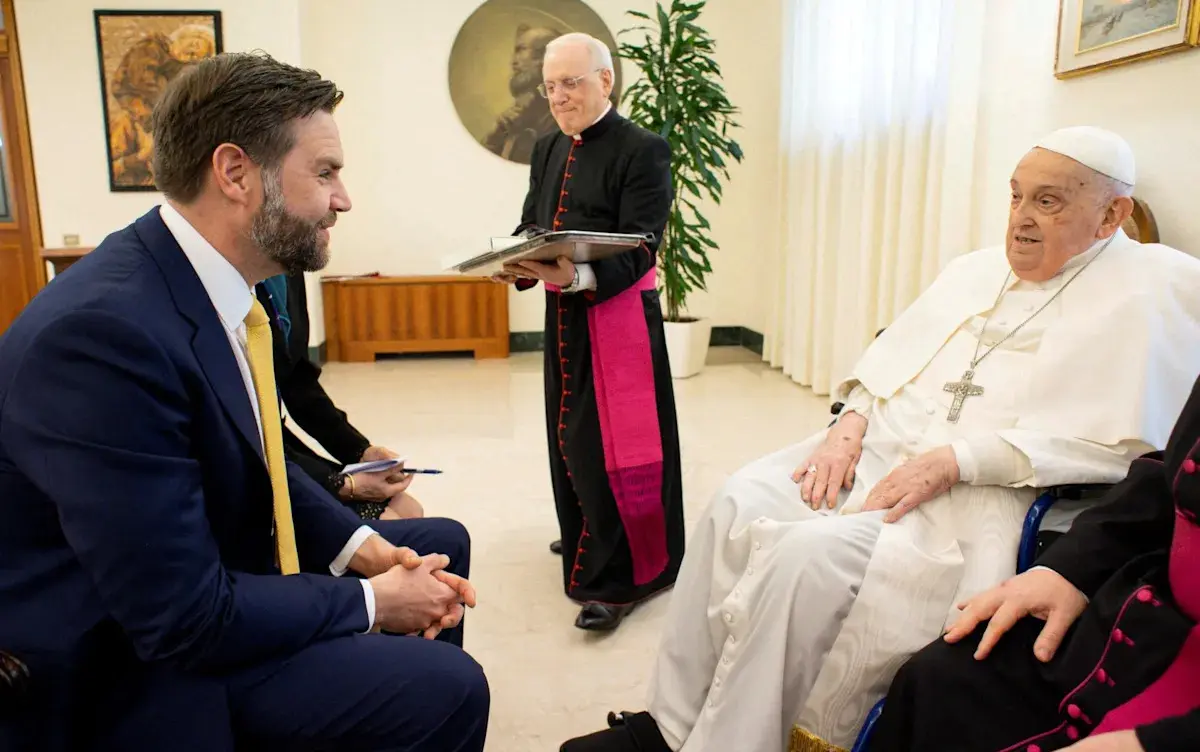
JD Vance has admitted he felt 'awful' for meeting Pope Francis just hours before the pontiff's death in April last year. The US vice president, writing in a new book about his conversion to Catholicism, was one of the last public figures to see the Pope before he died.
The Meeting
Mr Vance said he was pulled aside by a priest while on a state visit to Rome, who told him: 'The Pope would really like to meet with you while you're here. But he will decide in the morning whether he is up to it.' The Vatican and US diplomats 'were clearly worried about whether it would be seen as a snub if the meeting fell through,' Mr Vance wrote in his book 'Communion,' which was published on Tuesday.
'I felt awful about this,' the vice president added, saying he had wished the pontiff well and he should feel no pressure to receive him. But their 10-minute meeting went ahead the following day, on Easter Sunday.
Mr Vance, who converted to Catholicism in 2019, said he was 'unusually nervous' before seeing a visibly ailing Pope Francis. The pontiff was 'more fragile than I realized, and I felt even worse that he had forced himself out of bed early to meet with me,' the vice president wrote. 'Our visit was brief and informal. He gave the kids Easter gifts, and I told him we prayed for him regularly. After exchanging a few more pleasantries, we said our goodbyes.'
Mr Vance later told his wife, Usha Vance: 'It’s sad. He’s in very bad shape. But he was very kind.' Pope Francis died a day later, aged 88.
Vance's Journey to Catholicism
Vance's path to the Catholic faith is a central theme of his new book. Raised in a tumultuous household in Ohio, he struggled with faith until he encountered Catholic teachings during his time at Yale Law School. He was drawn to the Church's intellectual tradition and its emphasis on community and family. His conversion in 2019 was a deeply personal decision that he says reshaped his worldview.
The vice president has often spoken about how his faith informs his political views, particularly on issues like immigration and the sanctity of life. Despite disagreements with Pope Francis on immigration policy—especially the Pope's criticism of Trump's border policies—Vance says he found the Pope's teachings instructive. 'Pope Francis’s approach on immigration ... had forced difficult conversations,' Mr Vance wrote. 'Very often, I’d find myself initially annoyed by a comment he had made, but then I’d read more and learn something.'
The Book 'Communion'
The book reveals how Mr Vance regained his faith and discusses his conversion to Catholicism, how his faith guides his work in public life, and how it shapes his thoughts about the future. The book is published at an important time for the Catholic Church in the US. In the first year after the election of Pope Leo XIV, the first American pontiff, many Catholic churches across the country were welcoming more new members than in previous years. It also comes at a time when Mr Vance faces a consequential decision about his own future: whether to run for the presidency in 2028.
Rewarded for Badmouthing Trump
Mr Vance, who rose to prominence as a critic of Mr Trump before reinventing himself as a supporter of the president, denied making 'a politically cynical manoeuvre to gain political power.' In fact, he claimed, his politics changed as he 'looked inside our elite institutions and found them intellectually and spiritually broken.' After he emerged onto the national scene with the publication of 'Hillbilly Elegy' in 2016, Mr Vance said he found criticising Mr Trump 'lucrative' because it allowed for book deals and media appearances. 'I was rewarded for saying bad things about Donald Trump,' he wrote.
But, quoting the reasoning he gave to the New York Times, Mr Vance said: 'Like a lot of other elite conservatives and elite liberals, I allowed myself to focus so much on the stylistic element of Trump that I completely ignored the way in which he substantively was offering something very different on foreign policy, on trade, on immigration.'
Fourth Child on the Way
Mr Vance said his wife agreed to have a fourth child, expected to be born in late July, following the assassination of Charlie Kirk last year. Erika Kirk, the widow of the late influencer and activist, 'told Usha between sobs that she regretted [only] having two kids with Charlie,' he wrote. 'For years I had asked Usha to have another baby, and for years she had told me she was done… But something changed for Usha, and not long after we buried my friend, she became pregnant with our fourth child, a boy.' Mr Vance added: 'One life was stolen from us, but another was given.'
Workaholic Americans
Taking aim at aloof elites, Mr Vance criticises the US work culture, in which he argues Americans have sacrificed their faith and family to advance their careers. 'Workaholics' who outsource their cooking, cleaning, and childcare are 'screwed up,' he said. The vice president wrote: 'I started to grasp the devious hidden costs of this system. Work as much as you can. Achieve as much as you can. Make as much money as you can. If that means you don’t have time for the kids, fine. If that means you don’t even have kids, all the better.'
Mr Vance took aim at Americans who worked too hard and sacrificed family life as a result. 'I had thought these people were enlightened,' he said, referring to contemporaries at Yale Law School. 'But I began to see they were as screwed up as anyone.' 'What was the point of all this? It’s one thing to be a workaholic if you’re building a rocket to Mars,' Mr Vance continued, apparently referring to Elon Musk, the billionaire businessman who is expected to offer his support if the vice president runs for the White House in 2028. 'But most of us were not saving the world.'
Covid Panic-Buying
In early 2020, shortly before the birth of his second child, Mr Vance said he embarked on a 'paranoid' panic-buying spree after hearing early reports about the outbreak of Covid in China. 'I drove to a sporting goods store and bought one thousand rounds of ammunition,' he wrote. 'Then I went to Walmart and bought enormous bags of rice and flour, twenty pounds of ground beef, and excessive amounts of ketchup.' Mr Vance was asked by a woman at the checkout counter whether he owned a restaurant, to which he replied: 'No, but the China virus is coming.' In response, he said: 'She looked at me like I had an arm growing out of my forehead.'
Fears for His Children
Mr Vance, whose childhood was marred by his mother’s addiction issues, said he feared before he had children that he would 'abandon them or abuse them or fail them in some other way.' 'A voice in my head had been telling me that whatever short-term success I might have with Usha, I’d be unable to break free from the sins of people who’d died long before,' the vice president wrote. 'That my life was controlled by an invisible hand guided by the alcoholism and addiction and chaos of ancestors.' 'Hillbilly Elegy,' Mr Vance’s first book, related how he navigated his mother’s alcohol and drug problems while growing up in Ohio. In one incident, Beverly Vance is said to have accelerated a car while he was in the back seat, threatening to kill them both. The vice president also said he had confessed to conservative influencer Kirk that he feared he had 'ruined' the life of his eldest son, Vivek, with the public attention from his political career.
US Decline
Mr Vance, who is seen as one of the most isolationist members of the Trump administration, claimed US dominance was 'slipping away' on the world stage. He told of meeting a Ukrainian parliamentary leader at the Munich Security Conference in 2024, who 'wanted so desperately for the United States to wave a magic wand and give Ukraine what it needed.' The vice president continued: 'I asked him how many artillery shells and missile interceptors ... And when he answered, I told him (truthfully) that even if we gave him everything we had we’d fall short. The conversation heightened my sense of heartache for my colleagues as they watched our country’s position of leadership changing – or even slipping away. My colleagues who wanted to say yes, despite our country’s limitations, were misinformed. Naive even.' US senators at the conference were 'mourning' the end of a global order, following the end of the Cold War, in which 'the United States called the shots, virtually alone,' he said.
Background on Vance's Political Rise
James David Vance, known as JD Vance, was born in Middletown, Ohio, in 1984. He served in the Marine Corps, then attended Ohio State University and Yale Law School. After a brief career in venture capital, he gained national attention with his memoir 'Hillbilly Elegy,' which explored the Appalachian values and economic struggles of his upbringing. The book was adapted into a Netflix film in 2020. Vance ran for the U.S. Senate in 2022, winning a competitive race with Trump's endorsement. He took office in January 2023 and was later selected as Trump's running mate in the 2024 presidential election, becoming vice president in January 2025.
His relationship with Trump has been closely watched. Initially a 'Never Trump' conservative, Vance eventually became one of Trump's strongest allies, particularly on trade and immigration. As vice president, he has been a key figure in advancing Trump's agenda, including the border wall and deportation programs. His book 'Communion' is seen as a potential platform for a 2028 presidential run, with the subtitle 'How My Faith Transformed My Politics.'
The book's release coincides with a period of reflection for the Catholic Church in America, which has seen a surge in interest following the election of Pope Leo XIV. Vance's personal story of conversion and his public role have made him a prominent figure in the intersection of faith and politics. His description of his meeting with Pope Francis underscores the profound impact the late pontiff had on him, despite their policy disagreements.
Source:Yahoo News News