

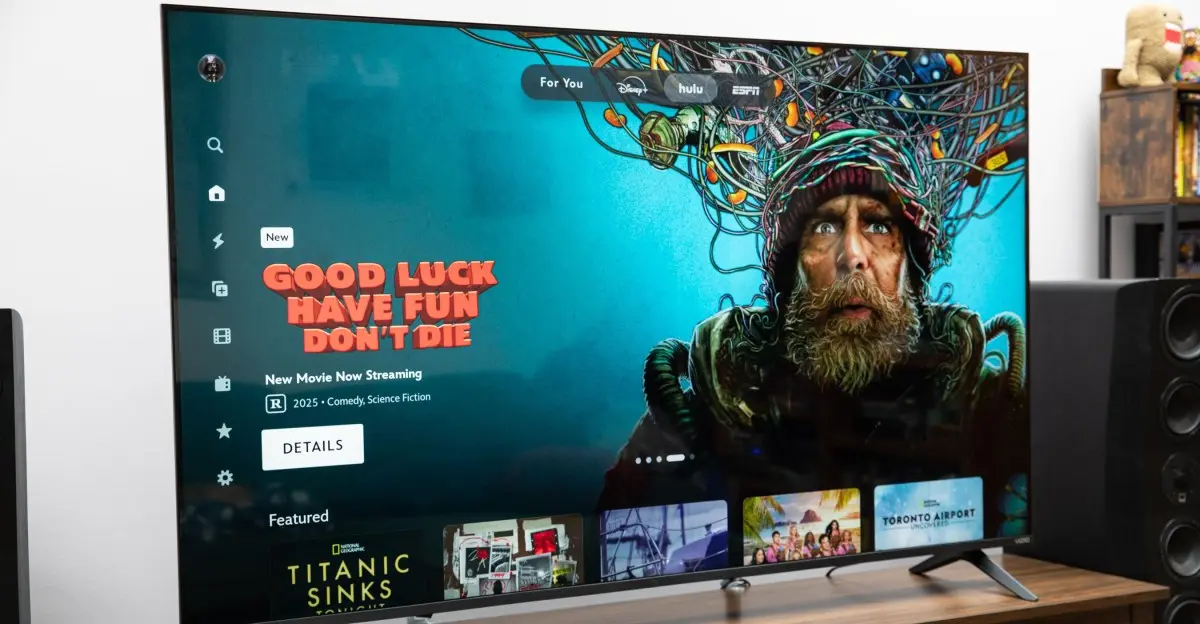
When Vizio released its Mini LED Quantum TV in mid-2026, the initial headlines focused on price: a 65-inch quantum-dot television for under $400, making it the most affordable QD-LED set on the market. But after spending time with the set, it became clear that the bigger story is not just the price—it's what you can do with it. Or rather, what you can avoid doing.
Vizio was acquired by Walmart in 2024, primarily for its advertising business. Since then, the company has integrated its TV operating system deeply with Walmart's retail and data ecosystem. The TV now requires a Walmart account to manage payments and subscriptions, and streaming apps cannot function unless users agree to an Activity Data Policy that lets Walmart collect all viewing habits. For many consumers, that level of tracking is unsettling—especially when it comes from a retailer that can link TV watching to shopping behavior.
Yet there is a loophole, and it is one that Vizio apparently never intended to leave open. During initial setup, users can decline the Walmart account sign-in and skip the Activity Data agreement. Doing so disables the smart TV features entirely, turning the Vizio into a dumb TV—a display that simply accepts HDMI signals and does nothing else. It can even be disconnected from Wi-Fi, ensuring no data is transmitted back to Vizio or Walmart.
This accidental dumb-TV mode is unique among major smart TV platforms. Most sets—including those from Samsung, LG, Roku, and Google TV—require acceptance of some data sharing to access even basic streaming or to complete initial setup. Vizio's process allows users to bypass everything, leaving a clean, ad-free, tracker-free display that works perfectly with an external streaming device like an Apple TV or Fire TV Stick.
The Hardware: What You Get for $400
The Vizio Mini LED Quantum TV uses an IPS panel with mini-LED backlighting and a quantum-dot layer. In SDR mode, the Calibrated picture mode reaches up to 936 nits of peak brightness—extraordinary for a budget set. HDR highlights can hit 579 nits, and the TV supports Dolby Vision, HDR10+, HDR10, and HLG. Color accuracy is good out of the box, though there is a slight blue cast in both Calibrated and Calibrated Dark modes.
However, the IPS panel limits contrast. Black levels are not as deep as those on VA-panel TVs, and blooming is visible around bright elements in dark scenes. The screen is also highly glossy, which can be distracting in rooms with lamps or windows. Motion handling is decent but shows some blur with fast-moving sports like Formula 1 drone shots.
Build quality reflects the low price: the entire back is plastic, there are only three HDMI 2.0 ports (no HDMI 2.1), and the feet offer only one height position. Cable management channels on the feet can only hold one cable each. The remote is small and cheap, and the built-in speakers are loud but lack fidelity. Still, for a 65-inch TV at this price, the trade-offs are reasonable.
How to Turn It Into a Dumb TV
The process is straightforward. On first power-on, the TV will ask for a Walmart account. Choose “Skip.” It will then ask you to accept Vizio's terms of service and privacy policy—you must accept these to proceed (they are required for basic functionality). Next comes the Activity Data Policy. Decline it. The TV will display a warning that smart features and streaming apps will not work. Confirm the decline. The TV will then switch to HDMI input mode, and you can plug in an external streaming device or antenna.
For full data avoidance, go into network settings and forget the Wi-Fi connection. You can also choose not to connect to the internet during initial setup, which immediately jumps to HDMI mode, but then you will miss firmware updates. To get updates while staying offline, you can connect the TV to the internet once, accept the terms and privacy policy (necessary for the TV to get updates), then after the update, decline the Activity Data Policy and disconnect Wi-Fi. That way you get the latest firmware without ongoing tracking.
The Broader Context: Smart TV Data Tracking
Vizio is far from the only company collecting viewing data. Smart TVs from Samsung, LG, Sony, and others all track what you watch—often without the user’s explicit knowledge. In 2017, Vizio paid $2.2 million to settle a lawsuit for collecting viewing data without consent. The difference now is that Walmart owns Vizio, creating a direct pipeline from your TV habits to shopping recommendations.
While some consumers may appreciate personalized ads and product suggestions (e.g., seeing Lego sets related to the shows they watch), many find the linkage between TV and retailer unsettling. The potential for abuse is real: your viewing history could influence not just ads but also pricing or inventory decisions.
By offering a way out—allowing users to skip the Activity Data Policy entirely—Vizio has inadvertently created the most privacy-friendly smart TV on the market, if you choose to leave it offline. The irony is that Walmart bought Vizio for its ad revenue, not to sell TVs. Yet the very design of the setup flow gives users a tool to escape that revenue model.
Performance and Value
For $398 (65-inch), the Vizio Mini LED Quantum delivers excellent value as a display. The quantum-dot layer provides wider color gamut than typical budget LEDs, and the mini-LED backlight improves brightness and contrast. In a dark room, Calibrated Dark mode offers pleasing color saturation with minimal artifacts. In a bright room, Calibrated mode maintains visibility thanks to high brightness, though reflections can still be an issue.
Gaming features are limited: 4K at 60Hz, 1080p at 120Hz on 65-inch and larger models, and no VRR or ALLM. For casual gamers, this is fine; for competitive gamers, it is a downside.
Audio support includes Dolby Atmos and DTS:X passthrough via HDMI eARC, but the internal speakers lack bass and clarity. A soundbar is recommended for immersive audio.
The biggest limitation is the lack of HDMI 2.1 ports. Most modern TVs now include at least one HDMI 2.1 input for high-bandwidth gaming. The Vizio Mini LED Quantum has three HDMI 2.0 ports, which cap at 4K/60Hz. This is acceptable for streaming and Blu-ray, but not for future-proof gaming.
How It Compares to Other Budget TVs
At the $400 price point, the Vizio Mini LED Quantum competes with TCL, Hisense, and Amazon Fire TVs. TCL's Q6 series offers quantum dots but uses a VA panel with deeper blacks. Hisense's U6 series also features quantum dots and often includes HDMI 2.1. However, those sets force users into their respective smart platforms with mandatory data collection—there is no way to fully bypass them.
Amazon's Fire TV line integrates deeply with Amazon's ecosystem and requires account creation to use most features. Roku TVs also require acceptance of data sharing for app access. Only Vizio allows the user to decline the Activity Data Policy and still use the TV as a basic monitor.
This makes the Vizio Mini LED Quantum a unique recommendation for privacy-conscious consumers who want a large, bright, affordable display without the baggage of smart TV tracking.
Long-Term Concerns
There is a risk that Vizio or Walmart could close this loophole in a future firmware update. If the TV is connected to the internet, an update might force users to accept the Activity Data Policy to continue using the TV at all. For now, the safest approach is to never connect the TV to the internet—or to connect only for firmware updates and then disconnect immediately.
Vizio has not commented on whether this ability to skip data collection is intentional or accidental. However, the setup flow, with multiple warning screens and a “Whoops!” message, suggests it is designed to pressure users into accepting tracking. The fact that you can still decline at every step indicates that someone in product design left the path open.
As long as that remains the case, the Vizio Mini LED Quantum is the best dumb TV you can buy. It delivers quantum-dot performance at a budget price, and it respects your privacy if you choose to leave it offline.
Source:The Verge News