

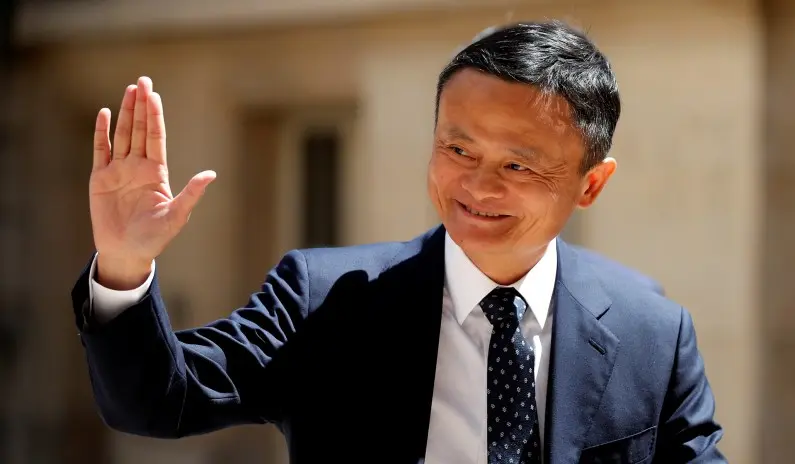
Chinese billionaire Jack Ma resurfaced on Wednesday after disappearing from public view for several months, easing concerns about his whereabouts and prompting Chinese e-commerce giant Alibaba’s stock to surge. In his first public appearance in nearly three months, Ma, 56, spoke over video at a virtual event called the “Jack Ma Rural Teachers Awards,” during which he gave remarks to dozens of teachers from rural schools. His appearance was followed by a spike in the stock price of Alibaba, the e-commerce giant he co-founded, which closed 8.5 percent higher on Wednesday.
“Jack Ma participated in the online ceremony of the annual Rural Teacher Initiative event on January 20,” the billionaire’s foundation said in a statement. The event, which Ma established in 2015, aims to recognize and support teachers in China's rural areas, reflecting his background as a former English teacher.
Background of Jack Ma
Ma Yun, known internationally as Jack Ma, was born on September 10, 1964, in Hangzhou, Zhejiang Province, China. He grew up during the Cultural Revolution and faced numerous challenges in his early life. Despite failing the college entrance exam twice, he eventually graduated from Hangzhou Teacher's Institute in 1988 with a degree in English. Ma worked as an English teacher for several years, earning a modest salary, before venturing into the business world.
In 1999, Ma founded Alibaba Group with 18 friends in his apartment in Hangzhou. The company started as a B2B marketplace connecting Chinese manufacturers with overseas buyers. Over the years, Alibaba expanded into consumer e-commerce through Taobao and Tmall, cloud computing via Alibaba Cloud, digital payments through Alipay, and logistics with Cainiao. Alibaba's IPO on the New York Stock Exchange in 2014 raised $25 billion, making it the largest IPO in history at that time.
The Disappearance and Speculation
Ma’s disappearance began in October 2020, after a speech at the Bund Summit in Shanghai where he criticized China’s financial regulatory system. In that speech, Ma described China’s financial regulators as having a “pawnshop mentality” and argued that regulations stifled innovation. The speech was seen as a direct challenge to President Xi Jinping's vision for economic governance.
Following the speech, Chinese regulators suspended Alibaba affiliate Ant Group’s $37 billion initial public stock offering, which would have been the world’s largest IPO, at the behest of Chinese President Xi Jinping. China’s market regulator also opened an investigation in December into Alibaba for alleged anti-competitive practices. Alibaba subsequently lost nearly $200 billion in market value.
Ma’s absence from public view for three months sparked widespread speculation. Some reports suggested he was under house arrest or had been detained by authorities. Others claimed he was lying low to avoid further controversy. The mystery deepened when he missed the finale of his own reality show, “Africa’s Business Heroes,” a competition he created to support African entrepreneurs.
The Return and Its Implications
Ma’s reappearance, albeit virtual, sent a positive signal to markets and investors. It suggested that the Chinese government might be easing its crackdown on the tech sector, or at least that Ma was back in the good graces of the Communist Party. However, the regulatory challenges facing Alibaba remain unresolved. The company is still subject to the antitrust investigation, and Ant Group has had to restructure its business to comply with new financial regulations.
The Rural Teacher Awards event, where Ma appeared, was a strategic choice. It highlighted his philanthropic work and reminded the public of his roots as an educator. Ma has long been involved in educational philanthropy, particularly in rural areas. In 2014, he established the Jack Ma Foundation, which focuses on education, environmental protection, and women's leadership. The foundation has donated millions of dollars to support rural teachers, build schools, and provide scholarships.
Ma’s net worth, estimated at $53 billion, makes him one of the richest people in China and the world. His rise from an English teacher to a tech tycoon is a classic rags-to-riches story, but his recent troubles underscore the challenges faced by entrepreneurs in China's tightly controlled economy.
Historical Context of Tech Regulation in China
China’s crackdown on its tech giants is not an isolated incident. In recent years, President Xi Jinping has emphasized the need to curb the power of monopolies and ensure that technology serves the public good. The antitrust investigation into Alibaba was part of a broader campaign that also targeted Tencent and other major platforms. In November 2020, regulators released draft guidelines to prevent anti-competitive behavior in the internet sector, signaling a shift toward stricter oversight.
Ant Group, originally founded as a payments affiliate of Alibaba, grew to become the world's largest fintech company. Its IPO was expected to raise over $30 billion, but regulators stepped in to ensure that it complied with financial stability and consumer protection rules. Analysts believe that the crackdown is aimed at reducing systemic risk and aligning the tech sector with the government's social and economic priorities.
Despite the regulatory headwinds, Alibaba remains a dominant force in Chinese e-commerce and cloud computing. The company has adapted by increasing investments in technology and expanding its international presence. However, the uncertainty surrounding Ma’s future role in the company has weighed on investor sentiment.
Philanthropy and Global Influence
Jack Ma is not just a businessman; he is also a global philanthropist and a symbol of Chinese entrepreneurship. During the COVID-19 pandemic, Ma donated millions of masks and test kits to countries around the world, including the United States. His foundation also shipped supplies to Africa and Europe, earning him praise for his humanitarian efforts.
Ma has been involved in various international initiatives, such as the Jack Ma Institute for Global Leadership, which aims to train future leaders from developing countries. He has also served as a special adviser to the United Nations Conference on Trade and Development (UNCTAD) on youth entrepreneurship and small business development.
Despite his global profile, Ma’s influence in China appears to be waning. After his speech and the subsequent crackdown, he has kept a low profile, avoiding public appearances and media interviews. His return to the public eye, albeit online, suggests that he may be able to continue his philanthropic work without further interference.
Future Outlook
The stock market reaction to Ma’s reappearance was positive, but the long-term outlook for Alibaba remains uncertain. The company faces intense competition from rivals like Pinduoduo and JD.com, as well as regulatory scrutiny that could impact its profitability. Ant Group, now under the supervision of China's central bank, is expected to undergo significant restructuring, including a potential reduction in its valuation.
For Jack Ma, his future role in the company he founded is unclear. He stepped down as executive chairman in 2019 but remains a major shareholder. Some experts believe that he may choose to focus on his foundation and educational projects rather than returning to an active role in business. Others speculate that the Chinese government may allow him to resume a limited public presence as long as he refrains from criticizing policies.
In the meantime, the story of Jack Ma continues to captivate the world—a tale of ambition, controversy, resilience, and philanthropy. His journey reflects the complexities of doing business in China under an authoritarian regime, where success often depends on navigating the delicate balance between innovation and political conformity.
Source:Yahoo News News