

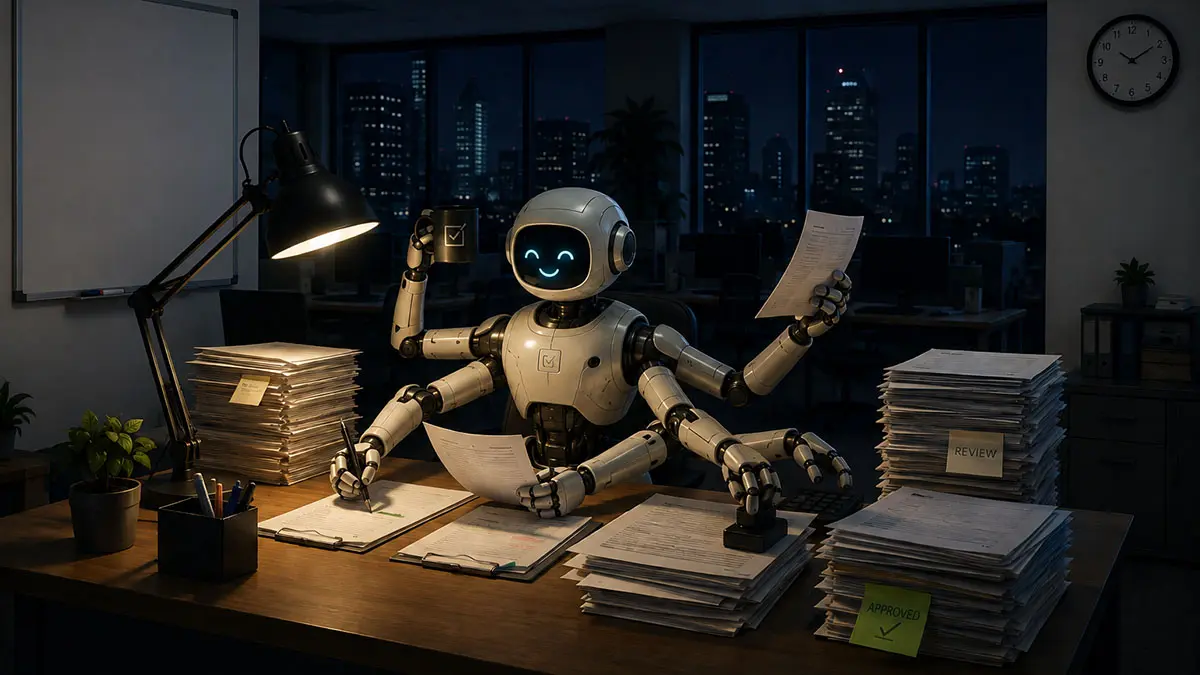
Elon Musk has long described artificial intelligence as both the most important technology and the greatest existential risk. His newest venture, SpaceXAI, is now acting on that belief by pushing systems beyond conversation. The company has announced Grok Bot, a new agent framework designed to turn AI models into always-on digital workers. The bot is intended to perform tasks independently, monitor ongoing operations, and learn from human correction, all without requiring someone to keep the process running.
The move is part of a broader trend known as agentic AI. Instead of asking a model a single question and waiting for an answer, users hand over an objective. The agent then breaks it down, chooses appropriate tools, and works through the steps. In the case of Grok Bot, the agent is expected to operate continuously. That means it can start work before a person opens their laptop and keep going after they log off, managing what employees would traditionally treat as daily administrative chores.
Key facts from the announcement
- Grok Bot is designed to work around the clock without requiring human initiation for each task.
- It can connect to external tools, APIs, and data sources to complete multi-step workflows.
- The agent can remember context across sessions and improve by learning from user feedback.
- SpaceXAI is targeting both individual users and enterprise clients with the system.
What Is Grok Bot?
Grok Bot is not simply a chatbot. It is an orchestration layer built on top of a large language model, similar in some ways to the agent tools being developed by other AI labs. The system can interpret a goal in plain language, plan a series of actions, and then carry out those actions using software. That might mean sending emails, updating files, querying databases, browsing the web, or coordinating with other AI agents.
The name Grok comes from Robert Heinlein’s novel Stranger in a Strange Land, where it means understanding something deeply. In the context of this launch, the implication is that the model is meant to understand not only language but also workflows. It should know what a user wants even when the instructions are vague. For example, a person might tell Grok Bot to prepare a weekly briefing on competitors. The bot would likely identify relevant sources, gather news, summarize shifts in strategy, and send the final report to the user’s inbox without any further direction.
This continuous operation is what separates Grok Bot from earlier virtual assistants. Many voice assistants and customer service bots are reactive. They wait for a specific command or a narrow trigger. Grok Bot is proactive. It is designed to run in the background, check on progress, and handle exceptions. If a particular source is unavailable, it can find another. If a report needs approval, it can notify the relevant person and then wait for permission before moving forward.
Why Always-On AI Workers Matter
The idea of an always-on employee is not new. Factories have used automated machinery for decades, and software robots have handled back-office tasks for years. But those systems are typically rigid. They can only follow the exact rules that were programmed. Grok Bot is meant to be far more adaptable. It uses language understanding to work with the messy, unstructured nature of modern knowledge work.
The potential economic impact is significant. Knowledge workers spend a large portion of their day on repetitive tasks such as sorting email, scheduling meetings, filling out forms, and searching for information. AI agents that can handle these responsibilities would free people up for creative and strategic work. They would also reduce the need for companies to hire additional staff when workloads spike. Instead, organizations could scale up with AI workers that are available on demand.
Always-on systems also offer a practical advantage: they can respond to events in real time. A human employee may start the day by reading messages that arrived overnight. An AI agent can handle those messages immediately, taking action or flagging urgent issues while the situation is still relevant. This could be especially useful for companies that operate across multiple time zones or serve customers who expect instant responses.
Changing the Relationship Between Humans and AI
One of the more interesting aspects of Grok Bot is the way it tries to shift user habits. Instead of treating AI as a search engine that must be prompted repeatedly, SpaceXAI wants users to delegate entire outcomes. The bot is expected to become a kind of digital assistant manager. It can maintain its own to-do list, keep records of what has been completed, and return with a summary only when necessary.
For individuals, this could translate into help with personal errands. A user might ask the bot to monitor a shopping site for the best price, compare shipping options, place an order within a certain budget, and track the delivery. Because the bot has access to historical context, it may also notice patterns. If a user normally books travel tickets on certain airlines or prefers certain seating arrangements, the bot could apply those preferences without being reminded.
In the enterprise, the potential is even greater. Companies could assign Grok Bot to support teams and have it handle a portion of inbound requests. It could draft contract summaries, conduct competitive analysis, generate code, run test cases, and even prepare documentation from meeting transcripts. The key is that the system would be continuously updated by the same models powering Grok, which means it improves as the main model improves.
The Competitive Landscape
The AI industry has been moving toward agentic systems for months. OpenAI has experimented with plugins, custom actions, and advanced tools that allow ChatGPT to perform tasks. Anthropic has demonstrated computer use, in which Claude can move a cursor and click buttons. Microsoft has embedded Copilot into Windows, Office, and other products. Google has been weaving AI deeply into Search and its Workspace suite. Grok Bot enters this competition with a clear focus on continuous autonomy.
SpaceXAI has an unusual advantage because of its connection to X, the social network formerly known as Twitter. Grok was originally built to understand and mirror public conversation on X. That gives it a unique view of real-time trends. An always-on agent for social media management could monitor mentions of a brand, detect growing complaints, draft replies, and publish approved messages. It could also follow journalists, analysts, and influencers to build daily briefings. This type of application would be difficult for rival systems to replicate as effectively, since the data belongs to X.
The rivalry does not stop at social media. SpaceXAI is likely to compete in the general assistant market as well. Grok Bot could be offered as a premium service inside X, just as earlier versions of Grok were tied to the platform’s subscription plans. It could also be licensed through enterprise APIs, allowing developers to embed always-on agent capabilities into their own products. The business model is still taking shape, but the long-term direction is clear: SpaceXAI wants to sell not just answers but actions.
Security and Privacy Risks
An always-on AI worker brings serious security implications. If a bot can access email, calendars, code repositories, and customer databases, the consequences of a breach could be severe. An attacker who gains control of a Grok Bot instance might be able to move laterally through an organization using the bot’s valid credentials. For that reason, companies will need strict access controls, monitoring logs, and maybe even dedicated tool suites that allow AI agents to act only within sandboxed environments.
Privacy is another concern. The bot will need to store and process potentially sensitive information to perform its tasks. If Grok Bot handles legal communications, medical records, or financial documents, it will be subject to regulatory requirements. Businesses will have to decide what data can be shared with the model and ensure that user consent is obtained. They will also need records of when the bot accessed a file or sent a message, especially if regulators ask about automated decision-making.
There is also the question of mistakes. Even the best AI models can be difficult to deploy in the real world because they sometimes make errors with complete confidence. With a chat system, a bad answer is annoying. With an action-taking agent, a bad action can be costly. If a bot accidentally submits a form, authorizes a payment, or deletes a record, the damage may not be reversible. SpaceXAI and other companies building AI agents will need to make failure modes transparent and ensure that humans remain in the loop for high-stakes actions.
Learning From Feedback
A major part of the Grok Bot concept is continuous improvement through feedback. When a user tells the system that a response is not correct, the bot should adjust its approach. This is different from updating a global model. Each instance can develop organization-specific preferences over time. A legal team’s bot would learn what style of memos it likes, while a customer support team’s bot would learn how to handle refund requests within company policy.
This type of personalization also raises questions about content moderation and misuse. If an organization purposely trains its bot to write misleading advertising or to answer calls improperly, should the provider intervene? And if a bot learns from biased feedback, who is accountable for the result? These are not entirely new questions, but they become more urgent when the bot is acting autonomously over long periods.
SpaceXAI will also have to address how users can regain control quickly. The interface cannot simply show a chat window if the bot has been running all night. Users will want dashboards, alerts, and audit trails that summarize what was done and why. A system that is always on also needs a clear off switch, so that a bot can be paused, rolled back, or put into a review-only mode whenever needed.
From Conversational Bot to Digital Coworker
Musk has often spoken about AI in highly ambitious terms. He was one of the early funders of OpenAI before later distancing himself from it. He later founded xAI, which produced the Grok series of models. The branding around SpaceXAI may be confusing, but the overarching goal is the same: build a useful and broadly deployed AI system that can act as an actual worker rather than a passive assistant. Grok Bot represents the latest step in that direction.
Musk’s other companies provide an interesting backdrop. Tesla has been working on autonomous driving, which can be seen as another form of always-on intelligence operating in the physical world. SpaceX has invested in massive projects that require software and hardware to run with minimal human oversight. The vision behind Grok Bot could eventually connect to those efforts. For instance, an AI agent might help plan factory schedules, monitor inventory, or coordinate communications across different business units.
The history of AI is filled with moments when a new capability goes from research experiment to commercial product. Chatbots became mainstream when OpenAI released ChatGPT. Image generation went mass market with tools like Midjourney and DALL-E. The next shift may be led by agentic systems. If Grok Bot achieves its goals, it will demonstrate that AI is more than a way to generate content. It will become a way to run operations continuously and effectively.
Adoption Hurdles and Enterprise Readiness
Enterprise adoption of AI agents will not happen overnight. Businesses need to see evidence that the system is reliable, predictable, and cost-effective. They will also need a clear return on investment. An AI agent that saves a few minutes per employee may not justify the integration effort. But an agent that can automate entire workflow categories could very quickly pay for itself.
A larger challenge is identifying which processes are ready for autonomy. Many organizational workflows still depend on human judgment, interpersonal communication, or physical oversight. Grok Bot will work best when the process is digital, documented, and governed by clear rules. Companies should start with low-risk use cases before granting the bot access to mission-critical systems. This gradual rollout may be slower, but it is more likely to gain trust from employees and regulators.
The job market will also face pressure. The term always-on worker makes many people uncomfortable because it sounds like automation replacing labor. The more realistic scenario is that AI agents will change the nature of many jobs. New roles will appear, such as AI operations managers, prompt engineers, and oversight coordinators. Workers may need to learn how to supervise digital coworkers. Meanwhile, occupations that rely mainly on repetitive digital tasks will see a structural shift in demand.
The launch of Grok Bot is also an invitation to think about the social and ethical design of autonomous systems. Should always-on AI be allowed to send messages on behalf of a human? Should it be permitted to make purchases under a certain dollar amount? What happens if two AI agents reach conflicting outcomes and begin fighting over a digital resource? These questions need answers before the technology is deployed at large scale.
SpaceXAI has promised to give users control and transparency, but those promises will need to be tested under real-world conditions. Whether Grok Bot becomes a mainstream productivity tool or simply another niche product may depend less on model intelligence and more on the quality of its guardrails. The future of AI workers will be built on trust as much as on capability.
The announcement makes one thing clear: the next phase of artificial intelligence will focus on action. Companies that build agents capable of managing entire workflows will create enormous economic value. Those that fail to protect users from privacy violations and automation errors will face backlash from the public and regulators. Grok Bot is entering that landscape with an aggressive design and an always-on philosophy, and its first major test will be whether it can act responsibly while working at machine speed.
Source:Techopedia News