

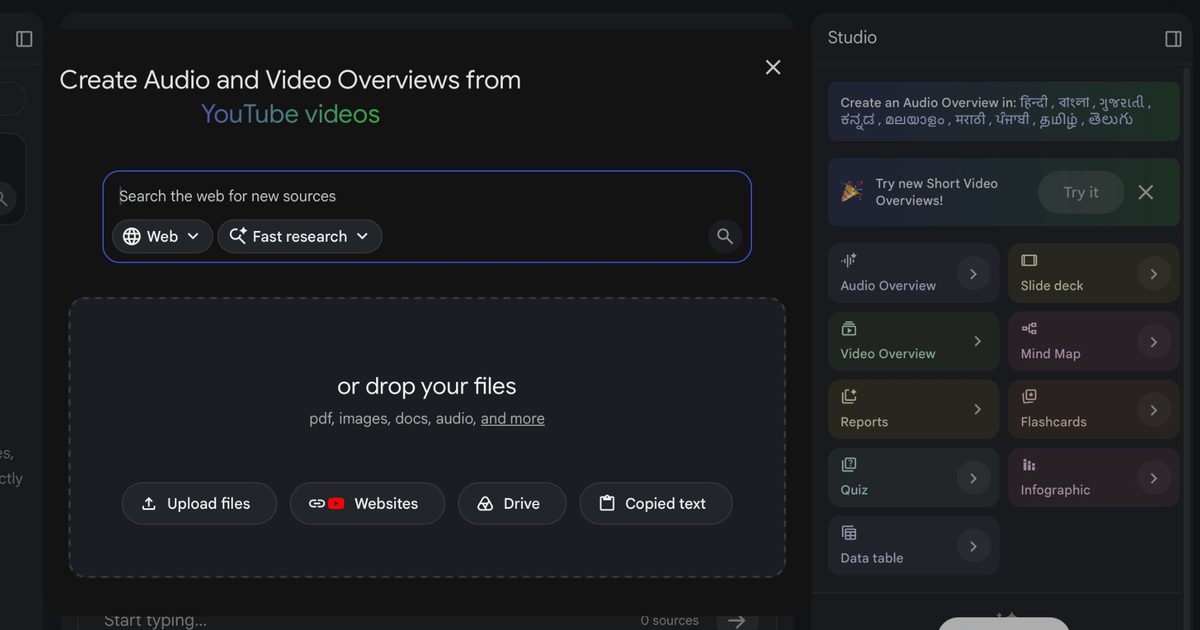
Short videos have taken over just about every app we use. You scroll through them on X, lose track of time on Instagram, watch them on YouTube, and now even Netflix has its own bite-sized feed. So when I heard that Google was bringing the format to NotebookLM, it felt both surprising and completely inevitable at the same time.
Google has announced Short Video Overviews for NotebookLM, a feature that turns dense documents and complicated sources into 60-second vertical videos that explain key ideas. Instead of staring at pages of notes, you get a quick visual walkthrough of the concept you’re trying to understand. The feature is part of Google's broader push to integrate generative AI into everyday productivity tools, leveraging its Gemini models to create dynamic, personalized content summaries.
Finally, a short video your brain will thank you for
Introducing this feature feels like one of those ideas where you wonder, “Why didn’t this exist sooner?” I’ve always found that if a concept is explained visually, it sticks with me much better than reading the same paragraph three or four times. If I had NotebookLM back when I was working on my university psychology thesis, I would’ve happily watched a handful of one-minute videos instead of digging through dozens of pages every time I needed a refresher.
That thought became even more real when I showed it to my nephew. He’s enjoying his school holidays right now, but next week he walks back into class and straight into a test. Over the last few days, he’s been looking at his pile of notes and growing increasingly anxious about how he’ll finish revising everything. So I asked him, “Why don’t you upload your notes to NotebookLM and see if it can explain them back to you as short videos?” You could almost see the stress ease a little. Suddenly, revision felt approachable. It’s obviously too early to say whether it’ll improve his grades; the feature has only just rolled out, but if it can help him understand a topic faster and make studying feel less overwhelming, that’s already a win.
The more I thought about it, the more I realized this isn’t just a feature for students. I can already imagine creators getting a lot out of it too. Anyone making educational or faceless content spends hours turning research papers, PDFs, reports, or long notes into something people will actually watch. If NotebookLM can handle the first draft of that process by creating a concise visual overview, that’s a lot of time saved. Additionally, journalists, researchers, and corporate trainers could use the feature to distill complex information into digestible clips for presentations or social media.
And honestly, it also feels like a nice twist on our collective obsession with short videos. We’re already spending hours flicking through vertical videos every day — I’m definitely guilty of it. So much so, I’m probably the last person who should be preaching about avoiding doomscrolling, but if I’m going to keep watching short videos anyway, I’d much rather a few of them actually make me smarter.
We’ve officially optimized our brains for 60 seconds
As excited as I am about this feature, it also left me with a slightly uncomfortable thought. The reason I instantly liked it is probably the same reason it exists in the first place: my attention span just isn’t what it used to be. So when Google says it can turn dense notes into a 60-second video, my first reaction is, “Honestly, I’d use that.” The funny part is that this feature is solving a problem we’ve slowly created for ourselves. We’ve trained our brains to expect information in bite-sized pieces, and now we’re building tools that fit how we consume content. It’s a little ironic, if you think about it.
This phenomenon is not new. Social media platforms like TikTok, Instagram Reels, and YouTube Shorts have reshaped how we consume media, favoring quick, emotionally engaging snippets over long-form content. Studies have shown that the average attention span has decreased from 12 seconds in 2000 to about 8 seconds today. By creating educational videos that fit within that window, NotebookLM is both catering to and reinforcing these habits. However, the tool’s potential for genuine learning is significant, especially for visual learners who struggle with text-heavy materials.
That said, I’d still call this a net positive. If those same 60 seconds that I would’ve spent mindlessly scrolling can instead help me understand a concept, revise a chapter, or finally make sense of something I’ve been putting off, I’ll happily take that trade. The key is intentionality: instead of consuming random entertainment, you’re consuming targeted educational content. With NotebookLM, you control what video appears next, turning passive scrolling into active learning.
Not in the club yet? You won’t be waiting long
Google is rolling out Short Video Overviews to NotebookLM AI Pro and AI Ultra subscribers on both mobile and the web, and thankfully, I was able to try it early. After spending some time with it, I can already see myself using it far more often than I expected. The experience is seamless: you upload a PDF, a research paper, or even a set of notes, and the AI analyzes the content to generate a concise, visually engaging video. The voiceover is clear and well-paced, similar to the AI hosts in NotebookLM’s earlier Audio Overviews feature.
There are a couple of limitations for now, though. The feature currently works only with English-language sources, so if your notes or documents are in another language, you’ll have to wait a little longer. The good news is that Google will likely expand language support over time, just as it has with many of its other AI features. Additionally, the tool works best with sources that have clear structure, such as articles, book chapters, or study guides. Highly technical or dense material may require manual tweaking to ensure accuracy.
And if you’re a free NotebookLM user, don’t worry — you haven’t been left out. Google has confirmed that this feature will be available to free users soon. So even if you can’t try it today, it probably won’t be long before you’re turning your own notes into bite-sized lessons too. The timeline for free rollout is still unclear, but based on previous NotebookLM updates, it could arrive within a few weeks.
From a technical standpoint, Short Video Overviews leverage the same underlying Gemini models that power other Google AI features. The AI extracts key points, identifies visual concepts, and generates a storyboard that combines text, images, and voice narration. While the output is not yet fully customizable — users cannot choose background music or specific imagery — the feature is already remarkably polished. It even includes on-screen text overlays and simple animations that help reinforce the spoken content.
For students, this tool represents a paradigm shift in how they approach revision. Instead of spending hours re-reading notes, they can now generate multiple short videos covering different topics within minutes. This is particularly beneficial for subjects that require memorization of facts, such as history, biology, or law. The visual and auditory repetition provided by the videos can improve retention and understanding.
For creators, the implications are equally profound. Educational YouTubers, online course instructors, and social media educators can use NotebookLM to repurpose existing content into new formats, saving time and reaching wider audiences. The tool can also assist in scriptwriting, as the generated video serves as a first draft that can be refined and expanded upon.
Despite the clear benefits, it’s important to acknowledge the potential drawbacks. Over-reliance on such tools may reduce deep reading and critical thinking skills, as users become accustomed to summarized information. There is also a risk of inaccuracies if the AI misinterprets complex data or omits crucial context. Therefore, users should always verify the generated videos against the original sources and use the tool as a supplement, not a replacement, for traditional study methods.
In the broader landscape of AI in education, NotebookLM’s Short Video Overviews join a growing list of tools designed to personalize learning. Competitors like Khan Academy’s AI tutor and Microsoft’s Copilot offer similar summarization features, but NotebookLM’s focus on video output and deep integration with user-uploaded sources gives it a unique edge. The ability to control which documents are used, and to generate videos on demand, aligns with the trend toward learner-centric education.
As we move forward, the line between entertainment and education will continue to blur. If tools like NotebookLM can transform our daily scrolling habit into a source of genuine knowledge, that would be a win not just for productivity, but for our collective intelligence. The next time you find yourself reaching for your phone to kill a few minutes, consider loading up a study guide instead of a social feed. You might just learn something new.
Source:Digital Trends News