

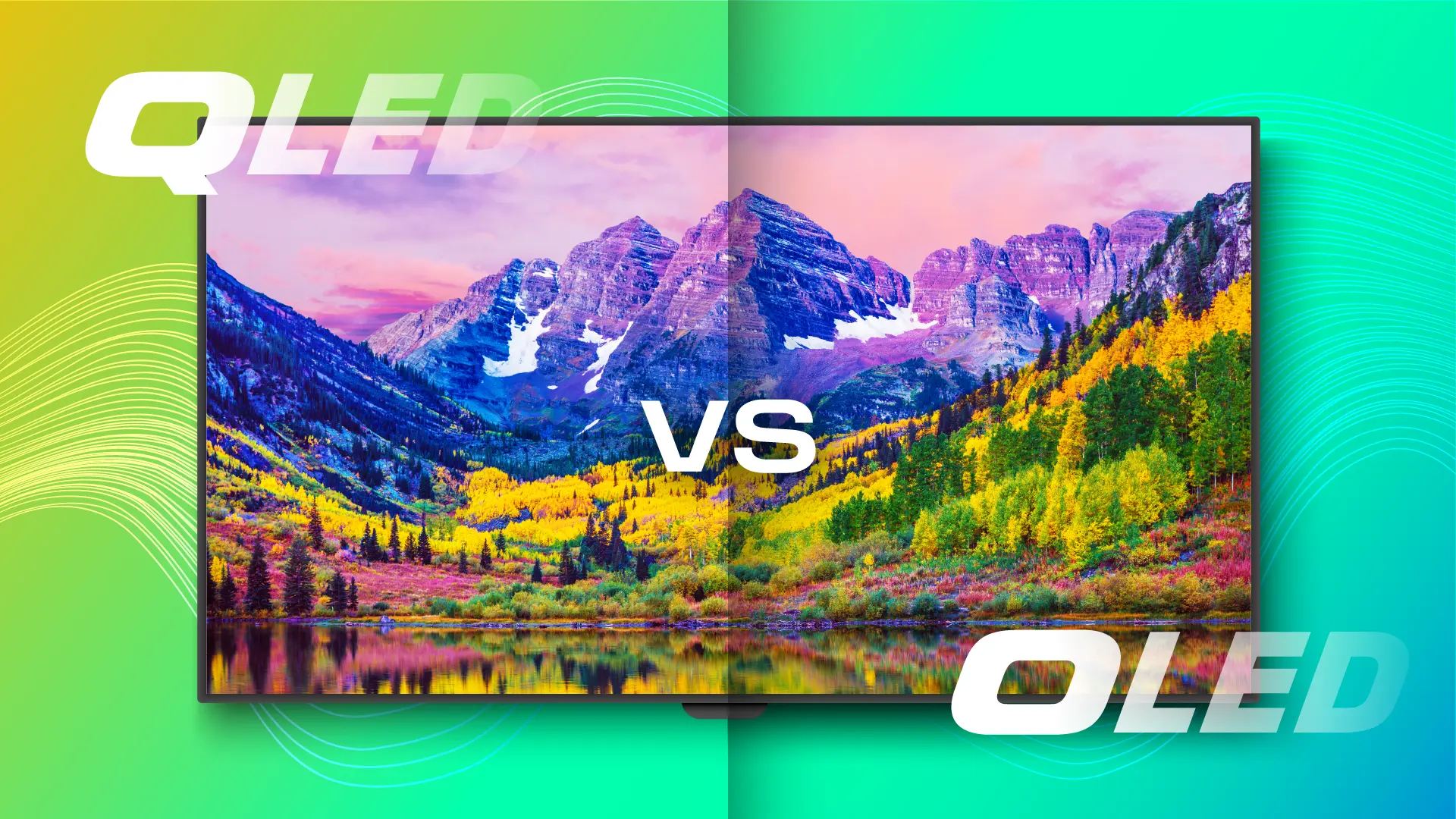
If you’re shopping for a new TV, you’ll encounter a mix of acronyms like HDR, 120Hz, HDMI 2.2, and the two most important: QLED and OLED. These terms describe entirely different technologies, and understanding them is crucial to making a smart purchase. This article explains the fundamental differences between QLED and OLED, their respective strengths and weaknesses, and which one might be best for your needs.
Quick Overview of the Technologies
OLED stands for organic light-emitting diode. It is an emissive display technology, meaning each pixel generates its own light. This allows for perfect black levels because pixels can be turned off completely. QLED, on the other hand, is a variation of LCD. It uses a quantum dot film placed over an LED backlight to enhance color and brightness. QLED is a transmissive technology, where light from the backlight passes through liquid crystals and color filters.
QLED vs. OLED: Picture Quality
Contrast and Black Levels
The most significant difference is contrast. OLED can achieve truly perfect black levels by switching off individual pixels, resulting in infinite contrast ratio. QLED/LCD TVs, even those with advanced local dimming, cannot match this because some light always leaks from the backlight. However, recent innovations like TCL’s Halo Control technology have brought QLED closer to OLED in black level performance.
Brightness
QLED TVs are generally brighter than OLED models. This makes them better suited for bright rooms with lots of ambient light, and they can deliver more impactful HDR highlights. OLED TVs have improved in brightness in recent years, but they still cannot match the peak luminance of the best QLED sets. For most home viewing conditions, however, OLED brightness is more than adequate.
Viewing Angles and Uniformity
OLED wins hands down on viewing angles. OLED screens maintain color and contrast even from extreme side angles, while QLED/LCD TVs suffer from color shifting and contrast loss when viewed off-center. OLED also offers superior screen uniformity with no backlight blooming or clouding, whereas LCD-based QLED sets can exhibit these artifacts, especially with bright elements on a dark background.
Color Accuracy and Volume
Both QLED and OLED can produce accurate colors, but QLED, especially with quantum dots, can achieve a wider color gamut and higher color volume. Samsung’s QD-OLED technology combines quantum dots with OLED to deliver excellent color performance. In side-by-side tests, the best QLED and OLED TVs are very close in color accuracy, but OLED often has the edge in naturalness due to its deeper blacks.
Screen Size and Price Considerations
OLED is available in a limited range of sizes: from 42 inches up to 97 inches. QLED, being LCD-based, can be manufactured in many more sizes, from 32 inches to well over 100 inches. Larger OLED TVs (77 inches and above) are significantly more expensive than comparable QLED models. For shoppers on a budget or those wanting a very large screen, QLED is more affordable. For those prioritizing picture quality in a typical living room size (55 to 77 inches), OLED offers the best value.
Burn-In and Lifespan
Burn-in is a potential issue for OLED TVs, where static elements like channel logos or news tickers can leave permanent ghost images. With normal varied content, burn-in is rare, but it is a risk for heavy users of news or sports channels. QLED/LCD TVs are not susceptible to burn-in, though they can suffer from temporary image retention. Both technologies are rated to last many years, but OLED’s organic materials may degrade over time, gradually reducing brightness. In practice, most TVs last at least five to ten years with typical use.
What About Mini-LED and MicroLED?
Mini-LED is an advanced backlight technology used in some QLED TVs, featuring thousands of tiny LEDs for better local dimming and higher contrast. MicroLED is an emissive technology similar to OLED but using inorganic LEDs, offering superior brightness and no burn-in risk. MicroLED TVs are currently extremely expensive and limited to large sizes, but they represent the future of display technology. For now, OLED and QLED remain the main consumer choices.
Which Should You Choose in 2026?
If picture quality is your top priority, OLED is the clear winner. Its perfect blacks, infinite contrast, uniform screen, and excellent viewing angles make it the best choice for movie enthusiasts and gamers who value image fidelity. If you watch TV in a very bright room, need a very large screen (85 inches or more), or are on a tighter budget, QLED is a fantastic alternative that offers excellent brightness and color at a lower price. Both technologies have evolved significantly, and the best choice ultimately depends on your specific room conditions and usage patterns.
Source:CNET News