

While wind turbines continue to improve in both efficiency and power generation, recycling them has been more of a challenge. And with the amount of waste expected to rise as wind power continues to garner more popularity, the situation calls for solutions. In 2025, New York's first wind farm was torn down, with some of its components potentially ending up in a landfill.
Fortunately, in addition to conventional recycling methods, one part of these machines (the nacelle) has found a new purpose as a tiny home. The project, "The Nestle Tiny House," is the first of its kind by Superuse Studios and a European energy company, Vattenfall. Perhaps more of these homes could be on the way. The nacelle (the large housing adjacent to the blades at the top of the structure) can apparently transform into modern living quarters once retired from service. The 376-square-foot structure includes a kitchen and bathroom with functional plumbing, along with a living room that presumably doubles as a bedroom when the sitting furniture is folded out. It also includes heating and a water heater, which are powered via solar panels on the roof.
Jos De Krieger, a key member of both the company behind the project (Blade-Made) and a partner at design firm Superuse Studios, told CNN.com, "Everything in the built environment — everything that you see around you — has an end of life. And we need solutions besides waste or landfill, incineration, or something without value." This approach demonstrates how components that would otherwise be discarded can be given a second life, reducing the environmental footprint of renewable energy infrastructure.
The average lifespan of wind turbines may surprise you: they typically have a service expectancy of up to 25 years. However, some units are failing sooner due to things like heavier-than-expected operational loads, blade erosion, and severe weather, to name a few. By far, the blades themselves remain the most difficult to recycle because of their exceptionally robust polymer construction. Jeremiah A. Johnson, an MIT Chemistry professor, explained regarding the blade material, "It's essentially one giant molecule. Every atom is connected through a 3D network," per Climate.MIT.edu. Due to this molecular structure, these blades can't be heated to a liquid and repurposed like other less resilient polymers.
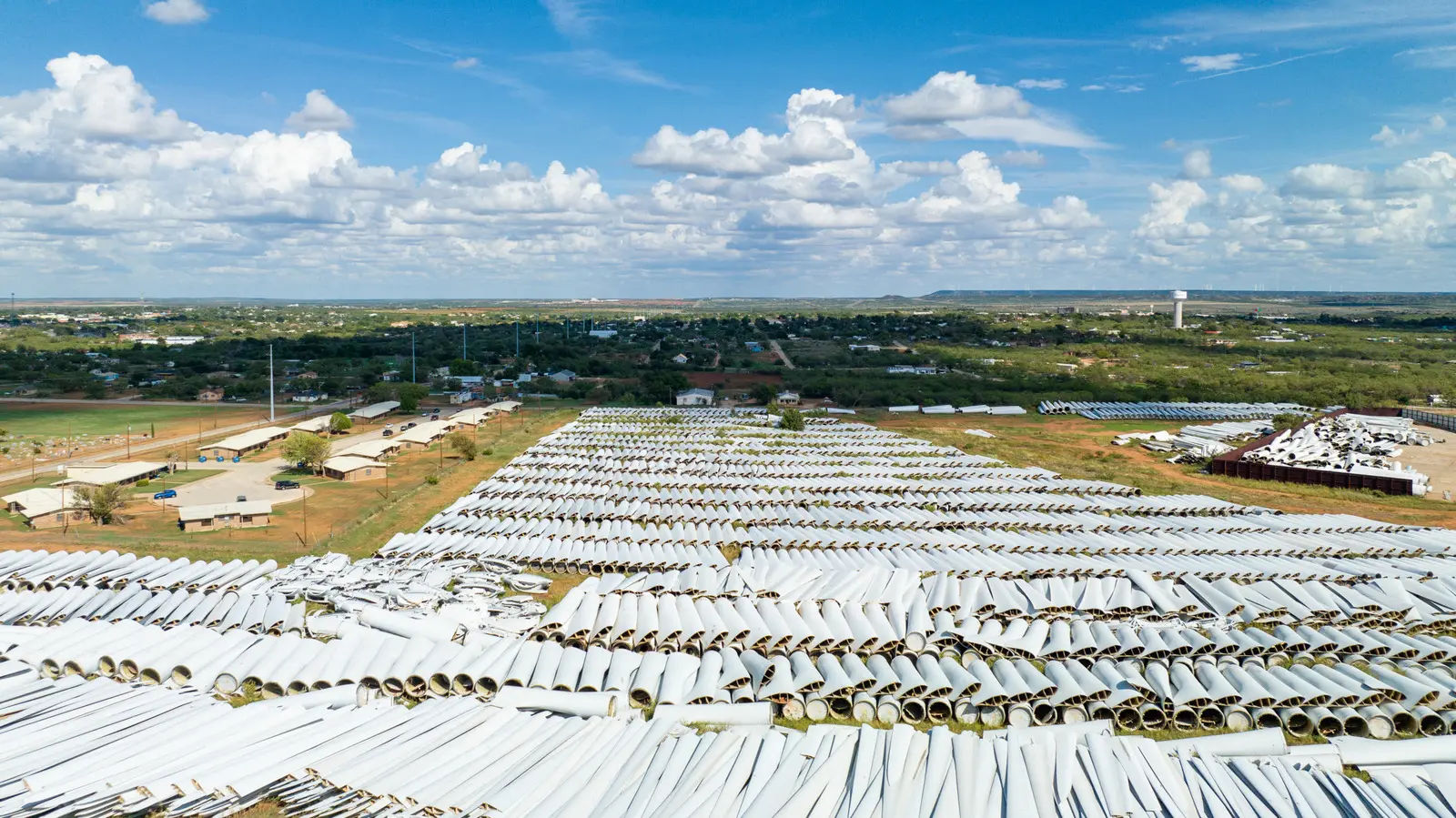
Without a straightforward way to recycle or reuse wind turbine blades, they can end up in large-scale heaps, such as one found in Sweetwater, Texas. This small town has been dealing with decommissioned wind turbine blades that, in 2023, covered an area north of thirty acres, with stacks several feet high. The visual impact is stark, but it also represents a lost opportunity for material recovery. The blades are typically made from fiberglass or carbon fiber reinforced plastics, which are designed to withstand extreme forces but are notoriously hard to break down.
Fortunately, efforts are underway to develop new ways to recycle these materials. Researchers at the University of Tennessee and Carbon Rivers have developed a method to break down the stout fiberglass from decommissioned blades so it can be reused to make new ones, per the U.S. Department of Energy. This process involves pyrolysis or chemical solvolysis to separate the glass fibers from the resin, allowing the fibers to be woven into new materials. In addition, news of a self-repairing material could allow cars, planes, and wind turbines to last for hundreds of years, which could go a long way toward reducing waste. Such materials incorporate microcapsules that release healing agents when cracks form, potentially tripling the operational life of turbine blades.
Beyond tiny homes, other creative reuse projects are emerging. Some decommissioned blades are being turned into public benches, playground structures, and even bridges. In Ireland, a project called "BladeBridge" uses retired blades as pedestrian footbridges, leveraging their curvature and structural strength. In Denmark, artists have turned blades into colorful bus shelters. The nacelle conversion into a home is particularly innovative because it retains the original shape and many internal systems, reducing the need for new materials. The Nestle Tiny House includes not only basic amenities but also smart home controls that optimize energy use from the rooftop solar panels.
The push to find new uses for old turbines is driven by both environmental and economic factors. The global wind energy capacity has grown rapidly, with total installed capacity surpassing 1,000 gigawatts in 2023. As early installations reach end of life, the waste stream could amount to millions of tons over the next decade. The European Union has been proactive, with some countries imposing landfill bans on composite materials. This regulatory pressure, combined with public scrutiny, is accelerating innovation in recycling and repurposing.
Vattenfall is also exploring other circular economy strategies, such as using recycled blade materials in cement production or as filler in asphalt. The company aims to have fully recyclable turbines by 2030. Similarly, Siemens Gamesa has launched a recyclable blade program called "RecyclableBlade," which uses a new resin that can be chemically broken down and reused. General Electric has partnered with companies to investigate blade repurposing for construction applications, such as noise barriers along highways.
The self-repairing material mentioned earlier is being developed by researchers at the University of Cambridge and the Massachusetts Institute of Technology. It involves a polymer matrix that contains embedded catalyst particles and monomer-filled microcapsules. When a crack propagates, the microcapsules rupture, releasing the monomer into the crack, where it comes into contact with the catalyst and polymerizes, sealing the damage. This technology could dramatically extend the life of turbine blades, potentially reducing waste by a factor of three or more. However, it is still in the laboratory phase and not yet commercially available.
Another promising area is the use of machine learning to predict blade failures, allowing operators to replace only the damaged sections rather than entire blades. This not only saves material but also reduces downtime. Companies like Spark Cognition are using AI to analyze acoustic emissions and vibration data from turbines to detect early signs of cracks or delamination. Predictive maintenance could extend average blade life from 20 to 30 years, significantly reducing the frequency of replacements.
The tiny home movement has also adopted other industrial materials, such as shipping containers, but the wind turbine nacelle offers a unique aesthetic and structural integrity. The Nestle Tiny House is currently a prototype, but Superuse Studios has received inquiries from numerous wind farm operators interested in converting their retired nacelles. The conversion process involves stripping the internal machinery, insulating the shell, installing windows and doors, and adding plumbing and electrical systems. Because the nacelle is already weatherproof and designed to withstand harsh conditions, it requires minimal additional reinforcement. The result is a compact, durable home that can be placed in remote or off-grid locations, further reducing its environmental impact.
While the concept of living inside a former wind turbine component may seem futuristic, it represents a practical solution to two problems: the need for affordable housing and the challenge of wind turbine waste. With the average cost of a new tiny home ranging from $30,000 to $60,000, a nacelle conversion could be significantly cheaper, especially if the housing is sourced from decommissioned turbines that would otherwise be scrapped. Vattenfall and Superuse Studios have not yet announced commercial pricing, but they estimate that the cost could be comparable to a similarly sized tiny home, given the savings on raw materials.
Looking ahead, the wind industry is also considering design for recyclability. Future turbines may be built with easily separable components and materials that can be returned to their original chemical building blocks. The European Commission's Circular Economy Action Plan has identified wind turbine blades as a priority product group, and funding is available for research into bio-based resins and natural fiber composites. Some startups are experimenting with blades made from recycled wood fibers and bio-epoxy, which could be composted at end of life. These innovations, combined with the repurposing initiatives described, promise to make wind energy truly sustainable from cradle to cradle.
The example of the Sweetwater, Texas, blade graveyard may one day become a relic of a less circular era. But for now, it serves as a stark reminder that the transition to renewable energy must be managed holistically, considering not just energy generation but also material flows. As Jos De Krieger noted, everything has an end of life, and the solutions we choose now will define the environmental legacy of the green revolution. The Nestle Tiny House and similar projects are proof that creativity and engineering can turn waste into valuable resources.
Source:SlashGear News