

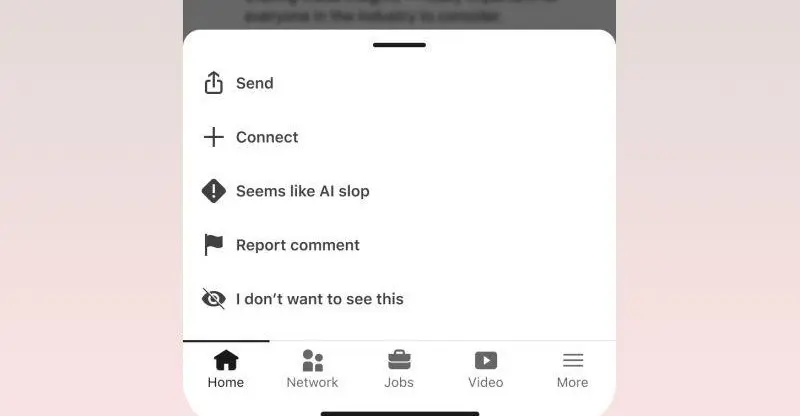
LinkedIn’s “Seems like AI slop” button has already been clicked more than one million times, according to the company’s chief product officer. The new tool gives users a way to flag posts that appear to be written by artificial intelligence rather than by a human being. Hari Srinivasan shared the usage milestone in a Thursday post, just a few weeks after LinkedIn introduced the button on July 30.
The button is located in the three-dot menu that appears on every LinkedIn post. Users can select “Seems like AI slop” when they believe a post was generated or heavily assisted by AI. It was designed to help the platform identify content that may be low effort, repetitive, or inauthentic, and to reduce the amount of such content in users' feeds.
What counts as AI slop?
“AI slop” has become a popular term for the flood of low-quality, mass-produced content generated with large language models. On LinkedIn, this often takes the form of long motivational essays, generic career advice, and hollow thought-leadership posts that offer little original insight. These posts frequently follow predictable structures, use buzzwords and emojis, and end with calls for engagement such as “Agree? 🔄” or “Share this with someone who needs to hear it.”
Many users have complained that LinkedIn's feed has become saturated with this kind of content. The professional network has become a prime venue for AI-generated posts because people use it to build personal brands, attract recruiters, or promote services. Some have turned to AI tools to generate inspiring posts at scale, hoping to increase their visibility without spending time writing original content.
Why LinkedIn decided to act
LinkedIn announced the AI slop button after an AI detection firm called Pangram analyzed longform posts on the platform and found that 41 percent of them were flagged as fully AI generated. The statistic surprised many users and sparked a broader conversation about how much of LinkedIn's content was authentic. Although AI detection methods are not always exact, the finding underscored the scale of the problem.
In response, LinkedIn introduced “new and improved” classifiers designed to identify AI-generated posts automatically. The company also removed a feature that would “enhance your post” with AI. That feature had allowed users to rewrite or polish their posts using AI tools, but it may have contributed to the very problem the platform was trying to solve. By removing it, LinkedIn signaled that it wanted to discourage AI-driven posting rather than encourage it.
Srinivasan said at the time that “AI slop is a top priority for all of us.” That comment reflected growing concern inside the company that the professional network was losing trust and becoming noisy. Unlike other social platforms, LinkedIn is meant to represent people's real professional identities, and a feed full of bot-like essays could undermine the value of the network.
Early results and feedback to users
In the Thursday post announcing the milestone, Srinivasan said users are now experiencing 40 percent fewer views of content classified as AI slop compared with just a few weeks ago. That suggests the combination of user flagging and automated classification is already changing what people see in their feeds. Fewer views do not necessarily mean fewer AI posts are being made, but the platform is limiting their reach.
LinkedIn is also adding a new message for people who publish posts that other members have flagged. The message will say: “Some members told us this post seems like AI.” The goal is to give feedback to authors rather than punish them immediately. Srinivasan said LinkedIn approached the feature “assuming good intent” and that the objective is to provide helpful feedback. He also said he has become increasingly conscious about how not to sound like AI, which suggests the feedback may influence how people write in the future.
How the flagging process works
When a user clicks “Seems like AI slop,” the action is presumably used as a signal to train LinkedIn's moderation systems. It is not the same as reporting a post for harassment, hate speech, or misinformation. Instead, it is a quality signal. LinkedIn likely aggregates these signals with its automated classifiers to decide whether to reduce a post's distribution or show a warning to the author.
The button may also help build a dataset for future moderation. By collecting millions of human judgments, LinkedIn can train its algorithms to recognize patterns that human users associate with low-quality AI content. This is a form of reinforcement learning that improves the system over time.
Broader context: AI content and social networks
LinkedIn is not the only platform dealing with an influx of AI-generated content. Social media networks, comment sections, review sites, and forums have all seen surges in AI-generated text since the release of ChatGPT and similar tools. Some companies have embraced the technology to help users write, while others have tried to limit its use because it can degrade the quality of public discourse.
LinkedIn's approach is notable because it gives users an explicit tool to express their opinion about whether something feels artificial. Rather than relying solely on algorithmic detection, the platform is crowdsourcing human judgment. This mirrors efforts by other platforms to let users flag misinformation or low-quality content, but it is specifically tailored to the problem of AI-generated text.
The term “slop” itself carries a negative connotation and has become part of the vocabulary around AI. It refers to content that is produced quickly and cheaply, often without much thought, and uploaded in large volumes. On LinkedIn, slop can be especially damaging
Source:The Verge News