

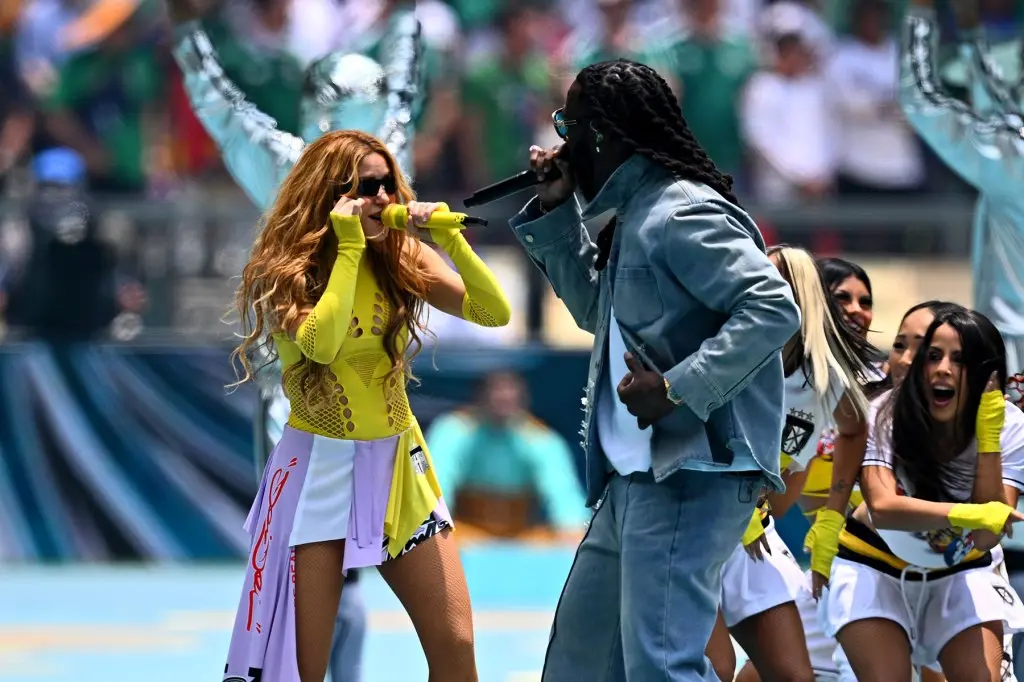
Goal! Shakira and Burna Boy debut on the Billboard Hot 100 (dated June 27) with “Dai Dai (FIFA World Cup Official Song 2026).” The song starts at No. 75 on the strength of 3.9 million official streams (up 47% week over week), 6 million airplay audience impressions (up 27%) and 2,000 sold (up 47%) in the United States during the June 12–18 tracking week, according to Luminate. This marks the fourth official World Cup song to hit the Hot 100, and the second for Shakira, who previously scored with “Waka Waka (This Time for Africa)” in 2010.
The respective Colombian and Nigerian stars performed the inspirational anthem for a reported 80,000-plus fans at the FIFA World Cup 2026 opening ceremony on June 11 at Mexico City’s Estadio Azteca. Soccer’s seminal tournament, hosted by Mexico, the United States, and Canada, runs through July 19. The performance was a highlight of the ceremony, blending Shakira’s signature rhythmic energy with Burna Boy’s Afro-fusion style, creating a global pop moment that resonated far beyond the stadium.
“Dai Dai” is the fourth official World Cup song to hit the Hot 100 — with two by Shakira. The history of official World Cup songs dates back to 1990 when FIFA first adopted them for the competition. Here’s a recap:
- 2026: Shakira x Burna Boy, “Dai Dai (FIFA World Cup Official Song 2026)” (No. 75 peak to date)
- 2014: Pitbull feat. Jennifer Lopez & Claudia Leitte, “We Are One (Ole Ola)” (No. 59)
- 2010: Shakira feat. Freshlyground, “Waka Waka (This Time for Africa)” (No. 38)
- 1998: Ricky Martin, “The Cup of Life” (No. 45, in 1999, amid buzz for his debut English-language album and its No. 1 Hot 100 smash “Livin’ La Vida Loca”)
As recapped in-depth by Billboard’s Griselda Flores, the World Cup began in 1930, but the Fédération Internationale de Football Association didn’t adopt official songs for the competition, played every four years, until 1990. The first official song was “Un’estate italiana” (Italian for “An Italian Summer”) performed by Gianna Nannini and Edoardo Bennato for the 1990 World Cup in Italy. That song did not chart on the Hot 100 but became a classic in Europe. The 1994 World Cup in the United States featured “Gloryland” by Daryl Hall and Sounds of Blackness, which also failed to break into the Hot 100. It wasn’t until 1998 that Ricky Martin’s “The Cup of Life” brought the tradition to American mainstream audiences.
“Dai Dai” concurrently surges to the top 10 (23-7) on the Billboard Global Excl. U.S. chart. It totaled 29.7 million streams (up 88%) and sold 6,000 copies (up 125%) beyond the U.S. during the tracking week. It also hits No. 1 on the latest Billboard Colombia Hot 100 and has gone top 10 on a dozen rankings in Billboard’s Hits of the World charts menu. The song’s rapid ascent reflects the power of World Cup-associated music to capture global attention, especially when tied to a massive live event.
Shakira’s involvement with World Cup songs is now legendary. Her 2010 collaboration with South African band Freshlyground, “Waka Waka (This Time for Africa),” became the best-selling World Cup song of all time, with over 3 million digital downloads worldwide at the time. It also reached No. 38 on the Hot 100 and was a smash across Latin America, Europe, and Africa. That song’s music video featured dance moves inspired by African traditional dances and the “Waka Waka” chant itself became a global phenomenon. Shakira also performed “Waka Waka” at the 2010 FIFA World Cup closing ceremony in Johannesburg.
Burna Boy, born Damini Ebunoluwa Ogulu in Port Harcourt, Nigeria, has become one of the most influential African artists in the world. Known for pioneering Afro-fusion—a blend of Afrobeat, dancehall, reggae, pop, and hip-hop—he has won multiple Grammy Awards, including Best World Music Album for “Twice as Tall” in 2021. His 2019 album “African Giant” was nominated for a Grammy and cemented his status as a continental icon. Collaborating with Shakira on a World Cup song introduces his music to an even broader audience, especially in Latin America and the United States where his streaming numbers have steadily grown. The “Dai Dai” collaboration was months in the making, with both artists recording in separate studios and eventually meeting in Miami to finalize the track. The song’s title, “Dai Dai,” is a Yoruba phrase meaning “patience” or “steadiness,” reflecting the perseverance and unity theme of the tournament.
This year’s World Cup is historically significant as it is the first to be hosted by three nations—Mexico, the United States, and Canada. The opening ceremony in Mexico City’s iconic Estadio Azteca, which also hosted the 1970 and 1986 World Cup finals, was a celebration of North American culture. The ceremony featured a parade of teams, a fireworks display, and musical performances by local and international artists. Shakira and Burna Boy’s performance was the centerpiece, lasting about seven minutes and incorporating dancers in traditional Mexican and Nigerian outfits. The live broadcast on Fox Sports and Telemundo drew an estimated 120 million viewers in the United States alone, according to early Nielsen ratings.
The Hot 100 debut of “Dai Dai” is notable not only for its chart position but for the streaming and sales surge it experienced in the week following the ceremony. The 47% increase in streams and sales suggests that the live performance had a strong immediate impact. Additionally, the song has been added to FIFA’s official World Cup playlist on Spotify and Apple Music, which have tens of millions of followers. This exposure has helped drive its global chart success, with the song entering the top 10 in countries like Mexico, Colombia, Nigeria, the United Kingdom, and Germany.
Beyond the charts, the song has cultural significance. It marks another chapter in the ongoing globalization of pop music, where artists from different continents collaborate to create a sound that resonates worldwide. Shakira, who has sold over 80 million records worldwide, has always blended Latin, Arabic, and pop influences. Burna Boy represents the rising wave of Afrobeats exports. Their collaboration on “Dai Dai” underscores how the World Cup serves as a platform for cross-cultural musical exchange. The song’s lyrics, which mix English, Spanish, and Yoruba, encourage listeners to keep going despite obstacles—a message that aligns with the competitive spirit of the tournament.
Looking at the other official World Cup songs that charted on the Hot 100, Shakira’s “Waka Waka” remains the highest-peaking at No. 38. Pitbull’s “We Are One (Ole Ola)” featuring Jennifer Lopez and Claudia Leitte reached No. 59 in 2014. Ricky Martin’s “The Cup of Life” peaked at No. 45 in 1999, boosted by his massive crossover success. “Dai Dai” currently sits at No. 75, but with the tournament ongoing and additional promotional performances expected, it could climb higher in the coming weeks. Historical data shows that World Cup songs often have a second wind during the final stages of the tournament, especially if the song is performed again at the closing ceremony.
From a production standpoint, “Dai Dai” was produced by Shakira’s longtime collaborator Luis Fernando Ochoa and Burna Boy’s frequent producer Kel P. The track features a driving beat, a brass section reminiscent of Latin marching bands, and a catchy call-and-response chorus. The music video, directed by Jora Frantzis, was filmed in both Mexico City and Lagos, Nigeria, showing the two artists performing in front of crowds of dancers against backdrops of football stadiums and urban landscapes. It premiered on YouTube on June 12 and has already garnered over 50 million views in its first two weeks.
In summary, “Dai Dai” continues the tradition of World Cup songs becoming global hits. With Shakira’s proven track record and Burna Boy’s rising star, the collaboration is a strategic move by FIFA to appeal to both Latin and African audiences. The song’s chart performance, while modest compared to some previous hits, is still a solid debut given the increasing competition in the streaming era. As the tournament progresses and more fans are exposed to the anthem through broadcasts, fan events, and social media challenges, “Dai Dai” could follow the path of “Waka Waka” and become a lasting memory of the 2026 World Cup.
Billboard will continue to track the song’s trajectory in the coming weeks, as it competes with other mid-year hits for chart positions. For now, Shakira and Burna Boy have added their names to a select list of artists who have penned the official soundtrack for the world’s biggest sporting event. The legacy of “Dai Dai” will be measured not only by its chart peak but by its ability to unite fans across borders through music—the very essence of both the World Cup and global pop culture.
Source:Billboard News