

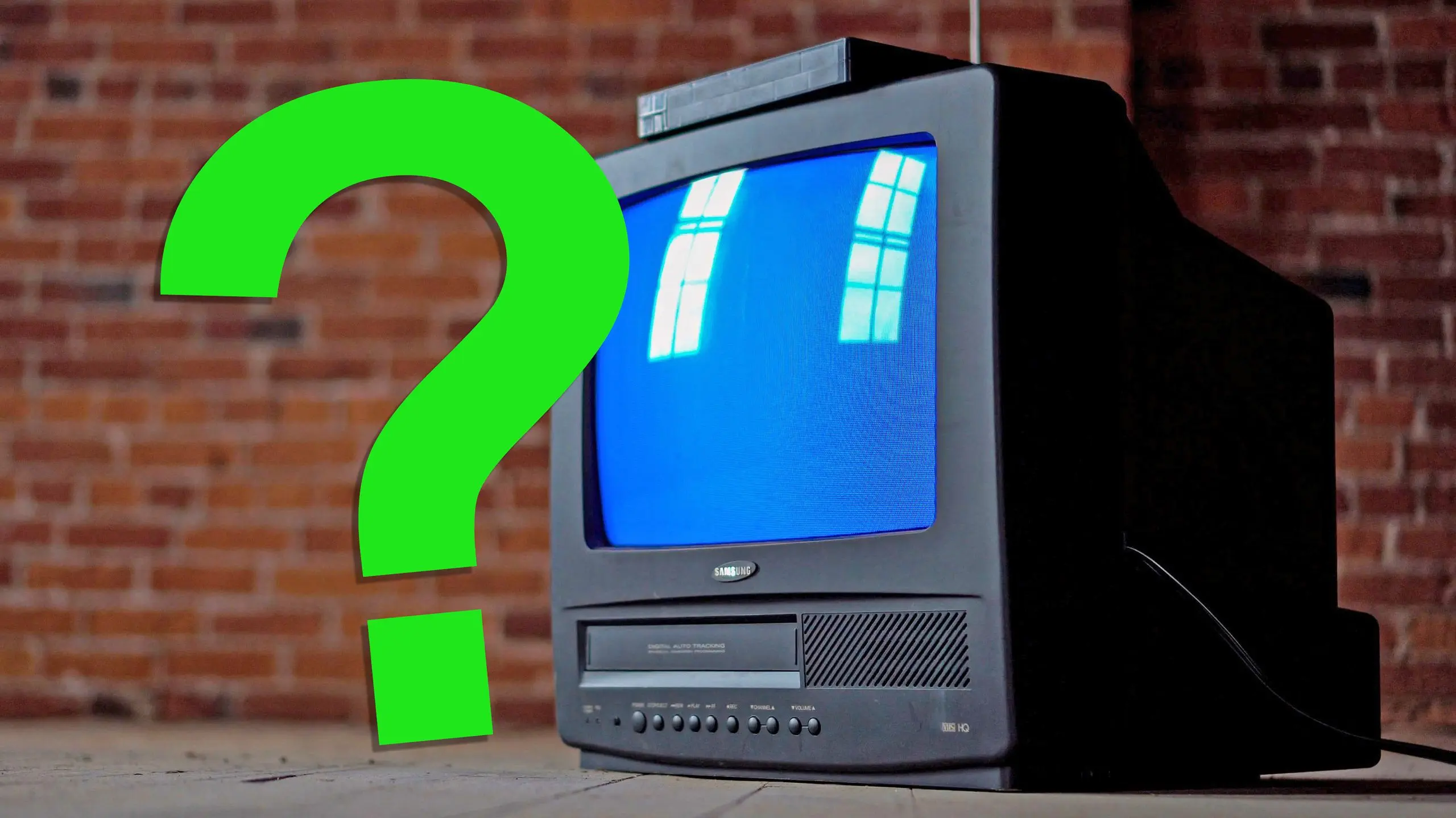
The glowing, bulky cathode-ray tube (CRT) televisions that dominated living rooms for decades are now museum pieces. Yet, a niche community of retro-gaming enthusiasts, film purists, and tech historians often wonder: could CRT TVs ever make a comeback? The answer, according to experts, is a resounding no — but not for the reasons you might expect.
When we think of obsolete technologies, we often assume they fade because consumers simply find something better. The smartphone killed the PDA. Streaming killed the DVD. But for CRTs, the story is different. As one veteran engineer from a former CRT plant explained, “Technologies don’t usually die because consumers move on, they die because the inputs disappear.”
The rise and fall of CRT technology
For over 70 years, CRT technology was the standard for television and computer monitors. The principle is elegantly simple: an electron gun fires a beam through a vacuum tube onto a phosphor-coated screen, illuminating pixels row by row. This analog technology offered deep blacks, zero input lag, and a natural motion handling that many modern LCD and OLED panels still struggle to match. It’s why competitive Super Smash Bros. Melee players still demand CRTs at tournaments, and why cinephiles value them for their authentic 480i display of standard-definition content.
At its peak in the 1990s and early 2000s, factories in China, Japan, South Korea, and Mexico churned out millions of CRT tubes each year. But the industry collapsed faster than almost anyone predicted. The introduction of flat-screen LCD and plasma panels, combined with falling costs and sleeker designs, caused demand to plummet. By 2010, the last major manufacturers — including Panasonic, Sony, and Samsung — had shut down their CRT production lines.
The overlooked obstacle: disappearing inputs
The common assumption is that if people wanted CRTs badly enough, a factory could simply restart production. But experts point to a fundamental flaw in that thinking: the entire global supply chain for CRT components has vanished. “You can’t just reboot a factory,” said a retired Sony engineer who worked on the Trinitron line. “The machines are scrapped. The raw materials? Gone. The skilled labor? Retired or dead.”
Consider what goes into a single CRT: special glass doped with lead and barium to withstand the vacuum and block X-rays; phosphors like europium-doped yttrium oxide for red, and silver-doped zinc sulfide for blue; electron gun assemblies that require micron-level precision; and degaussing coils, shadow masks, and countless other parts. Each of these components had dedicated suppliers that also shut down. The raw materials, particularly rare-earth phosphors, are no longer produced in the quantities or specifications needed for CRTs.
Phosphor supply: the quiet killer
The biggest surprise is that the most critical input — phosphor — is virtually unobtainable. Modern LED and fluorescent lighting uses different phosphor formulations. CRT phosphors had to be optimised for electron-beam excitation, not UV or blue-LED pumping. The few researchers who still study CRT phosphors note that the chemistry is well-understood, but manufacturing requires furnaces and clean rooms that were custom-built for CRT production. No company exists today that can produce the specific green P1 or P4 phosphor in bulk. “It’s like wanting to print a book with a printing press that’s been melted down for scrap,” an analyst commented.
The structural barriers to revival
Even if a wealthy enthusiast funded a boutique CRT factory, the economics would be brutal. The tooling for cathode-ray tubes is extremely specialized: giant rotary machines to frit-seal the faceplate to the funnel, high-voltage testers, and vacuum pumps capable of creating nearly 10^-8 torr. Replicating that infrastructure from scratch would cost hundreds of millions of dollars, and the resulting tubes would likely sell for thousands of dollars each, far beyond what the retro market can bear.
Moreover, safety regulations have changed. Modern electronics are subject to RoHS and other environmental directives that restrict lead and other hazardous substances. CRTs contain up to 2.5kg of leaded glass and beryllium in the cathode assembly. A new production line would have to comply with 21st-century environmental laws, adding immense cost.
Why the nostalgia won’t overcome the obstacle
Some argue that if enough people demand CRTs — for retro gaming, for vintage computing, or for the unique aesthetic — the market would eventually find a way. But historians point out that similar revival attempts for vacuum tubes (valves) in high-end audio have succeeded only because the manufacturing scale is much smaller and the inputs less specialized. Vacuum tubes for guitar amps can be made using generic glass and wire; CRTs require custom phosphor and a perfectly curved shadow mask.
“CRTs are not like vinyl records, which only need a pressing plant,” said a curator at a technology museum. “A record pressing plant is simple compared to a CRT plant. It’s more like trying to revive a CRT is like trying to revive a species after its habitat is completely destroyed.”
The environmental and cultural legacy
Ironically, the very disposability that doomed CRTs is now a problem. Millions of old CRT tubes sit in landfills or warehouse, leaching lead into the soil. Recycling efforts are expensive because the glass is contaminated with lead and coatings. Some municipalities still struggle to dispose of the estimated 1.2 billion CRTs produced worldwide. “We can’t even responsibly get rid of the old ones, let alone start making new ones,” noted an e-waste specialist.
Despite this, CRT technology has left an indelible mark. The deep blacks, the soft glow, and the authentic scan lines are beloved by artists, photographers, and gamers. Some modern monitors have tried to emulate the look digitally, but experts say nothing beats the real thing where the electron beam physically hits the phosphor. Still, without the inputs, the magic cannot be replicated.
As one former CRT factory worker put it, “We didn’t die because people stopped wanting us. We died because the ingredients ran out. It’s like making a cake with no flour, no sugar, no oven. You can have the best recipe in the world, but you’ll never bake a thing.”
So the next time you see a grainy photo of an old wooden TV console and feel a pang of nostalgia, remember: the biggest reason you’ll never see a new CRT on the shelf isn’t that no one wants it. It’s that the very building blocks of the technology — the input materials — have disappeared from the industrial landscape, leaving behind only memories and a world of e-waste.
Source:TechRadar News