

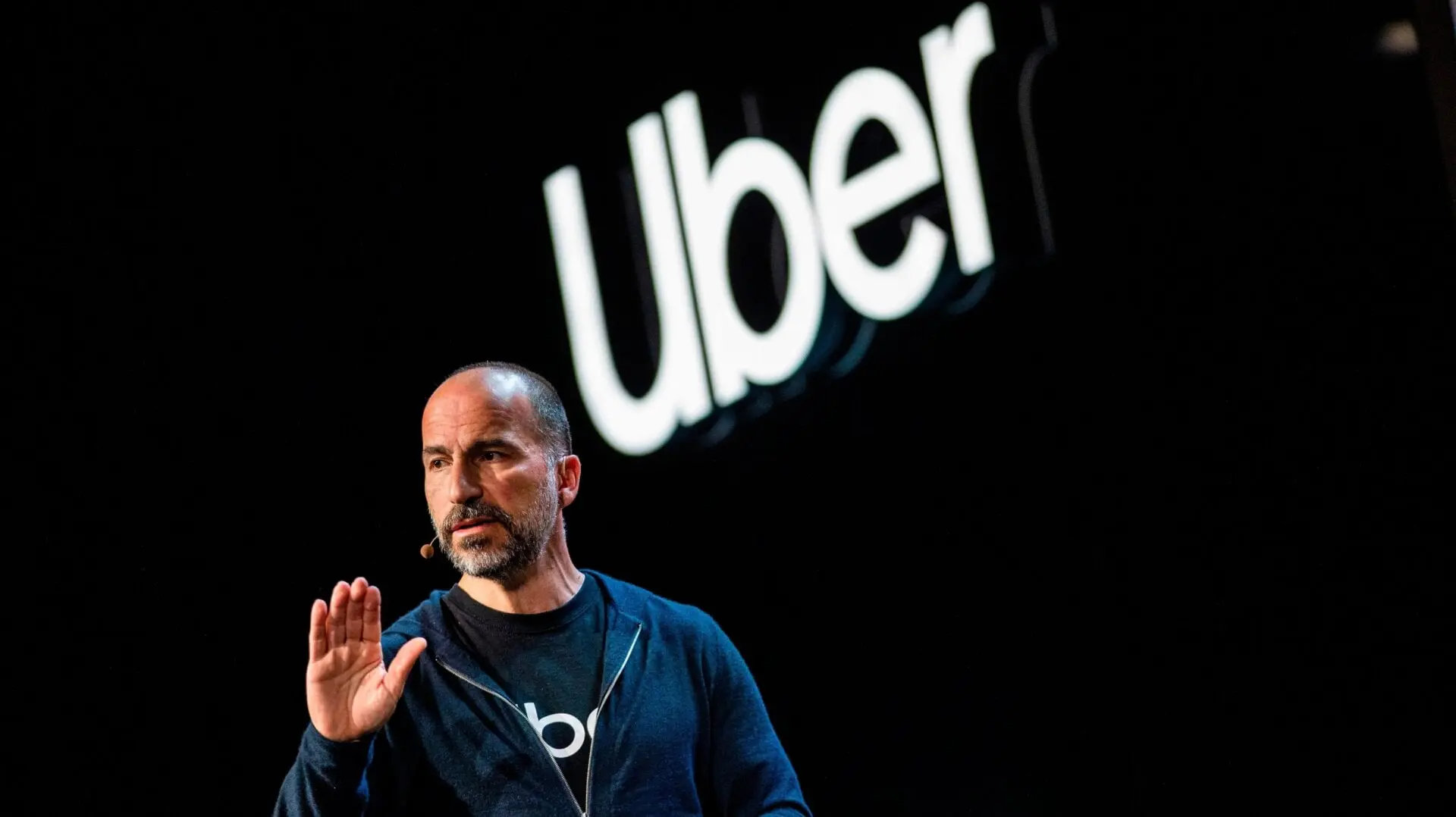
Uber is cutting about 10% of its workforce, or roughly 3,300 employees, in a sweeping organizational shake-up that takes direct aim at middle management. The ride-hailing company confirmed the layoffs Wednesday after CEO Dara Khosrowshahi sent a memo to staff describing an organization that had become slow, layered and difficult to navigate.
“We are removing layers, simplifying team structures, refining our global location strategy, and focusing our people and investments against the biggest opportunities ahead of us,” Khosrowshahi wrote in the memo, which was later shared with the public.
The cuts are being framed as a major reorganization rather than a financial correction. Most of the roughly 3,300 roles being eliminated are middle-management positions, a category that expanded quickly across Silicon Valley during the post-pandemic hiring boom. In recent years, some of the biggest names in technology moved away from flat startup hierarchies and toward more traditional corporate structures, adding layers of managers and coordinators.
At Uber, that meant a widening gap between executives and the people doing the work. According to the company’s announcement, Uber is reducing the number of employees who sit seven or more layers below the CEO by about 20%. It is also cutting the number of “micro-teams,” or teams with only one or two direct reports, by nearly 50%. Both changes are intended to collapse the distance between top executives and front-line product, engineering and operations staff.
The layoffs arrive just weeks after Uber reported $14.2 billion in quarterly revenue and $2.4 billion in net income. Both figures were significantly higher than in the same period a year earlier, making the cost-cutting difficult to explain solely through the lens of market pressure.
Khosrowshahi acknowledged as much in the memo. Despite the company’s healthy finances, he wrote that growth has “brought complexity.” He pointed to more layers, more coordination and more fragmented ownership across projects—problems that, in his view, no longer serve the company’s goals.
Why middle management became a target
Middle management has long been singled out as a source of friction in large organizations. Instead of helping teams execute faster, managers can become bottlenecks, translating too much information from upper executives and passing down instructions with little added value. That criticism has grown louder in an era when messaging apps, shared documents, and internal dashboards already provide workers with constant visibility into company priorities.
The language in Khosrowshahi’s memo echoes a broader Silicon Valley trend. Executives at Amazon and Meta have in recent years cut jobs while insisting that their companies had become too unwieldy to move quickly and innovate. “Bureaucracy” has become a dirty word in boardrooms across the technology industry, with leaders invoking images of endless meetings, redundant approvals and ambiguous decision rights.
In Uber’s case, the company is attempting to balance scale with speed. Founded in 2009 and now operating in hundreds of cities around the world, Uber has grown from a startup that matched riders with drivers into a sprawling logistics platform encompassing food delivery, freight, and autonomous vehicle development. That scale brought new lines of revenue but also created overlapping teams and duplicated efforts.
Some of that hiring was intentional. During the pandemic, when ride-hailing demand temporarily collapsed and then surged back quickly, Uber added employees to handle new categories and to strengthen trust-and-safety operations. But the company kept many of those layers even as growth normalized, leaving it with a structure that Khosrowshahi believes is too heavy.
The question at the center of the announcement—AI or overhiring?—will likely follow Uber through the next several quarters. For now, the company has not described the latest reductions as an AI-driven layoff. The word artificial intelligence does not appear in Khosrowshahi’s memo. But technology executives across the industry have begun to acknowledge that generative AI tools can absorb work that once required additional head count.
AI is not in the memo, but it is in the background
Uber has already moved in that direction. Khosrowshahi said earlier this year that about 10% of all code generated at Uber is now built by AI agents. The company has also integrated AI tools into legal and marketing workflows, with employees increasingly relying on large language models for drafting, research and analysis.
A June report added another detail: Uber had put spending caps on some AI tools after blowing through its annual AI budget in just a few months. The episode suggested that internal enthusiasm for AI had outpaced the company’s financial planning, even as executives began to treat AI as a source of productivity.
At the time, the company also said it would slow hiring because of the growing benefits of AI, according to the report. That statement gave an early signal that AI would begin to replace some human roles even if the formal justification for layoffs was about organizational design.
Uber is not alone in making that connection. Earlier this year, Block, the financial services company led by Jack Dorsey, cut more than 4,000 jobs. In a memo explaining the cuts, Dorsey wrote that the company’s intelligence tools made it possible to operate with “smaller and flatter teams.” The phrase was almost identical to the rationale now being offered by Khosrowshahi, even if neither executive openly says AI agents are replacing people.
The tension between those two narratives—AI-driven efficiency versus a simple cleanup after years of overhiring—has become a defining theme in tech layoffs since the release of generative AI tools. Companies often have multiple reasons for reducing head count, and those reasons are rarely captured in a single word on a slide presentation.
There is also a competitive dimension. Startups building AI-powered agents for customer support and internal operations are increasingly targeting the same travel and logistics market where Uber operates. If Uber can maintain its platforms with fewer staff members, it can invest more heavily in the next wave of automation rather than protecting legacy jobs.
The autonomous vehicle threat
Uber is also navigating a competitive landscape that looks very different from the one it dominated a decade ago. Alphabet’s Waymo is now providing fully autonomous rides in 14 U.S. cities and is expanding rapidly into new markets. What was once a futuristic demonstration is now a commercial service operating in major metropolitan areas, and it is already having an effect on traditional ride-hailing drivers.
In Atlanta, where Waymo rides are booked through Uber, some Uber and Lyft drivers told reporters that they have seen lower earnings, fewer ride requests, and longer waits between rides since Waymo launched in the city last year. The anecdotal reports, if representative, suggest that robotaxis are not just a future threat but a present competitive force.
Uber has responded by making its own bets on autonomous vehicles rather than simply treating them as rivals. The company has struck partnerships with several vehicle technology companies, including Lucid, Nuro and Rivian, to develop a robotaxi fleet. It also plans to invest more than $10 billion to bring autonomous vehicles to market at scale.
Those investments require capital, and they may require a leaner organization. If Uber intends to move into the capital-intensive business of operating and maintaining an autonomous fleet, it will need to free up resources from elsewhere. Cutting layers of management is one way to redirect money and energy toward long-term autonomy bets.
The company has also pledged more support for its core marketplace. In Wednesday’s memo, Khosrowshahi wrote that the layoffs would give Uber more capacity to invest in drivers, couriers and merchants, as well as to “build the autonomous future.” That line captures the central tension in the announcement: the same reorganization that removes thousands of jobs is being described as an investment in the people and technologies that Uber believes will define its next stage.
Source:Gizmodo News