

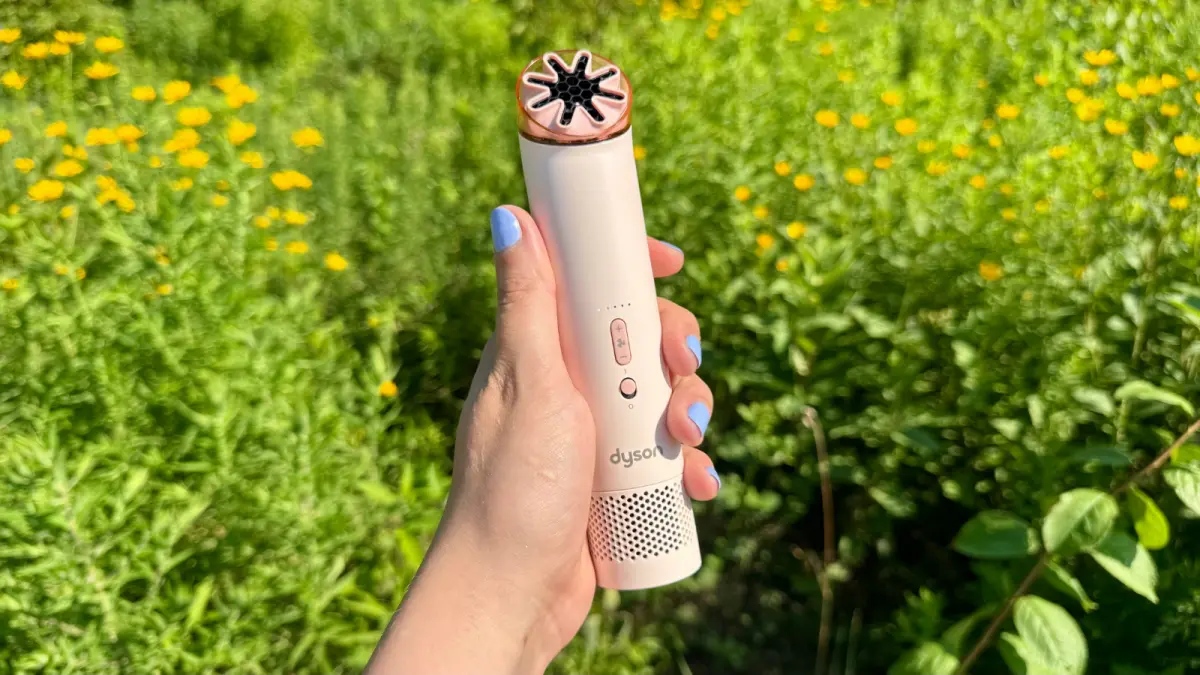
Summer heatwaves have become increasingly common across the globe, and with them, the demand for portable cooling solutions has skyrocketed. The Dyson HushJet Mini Cool enters the market as a premium option, promising bladeless technology and powerful airflow in a compact form factor. Priced at $99.99, it sits at a curious intersection: far more expensive than the $10 handheld fans found on Amazon or Temu, yet still cheaper than Dyson's larger room fans. To see if it truly delivers on its promise, we subjected the HushJet Mini Cool to two severe heatwaves — one in London and another in Chicago — and put it through rigorous testing.
Design and Build Quality: Lightweight but Unconventional
The HushJet Mini Cool features a tubular body that houses a brushless DC motor. Air is drawn in through small intake holes at the base and expelled through a starburst-shaped nozzle, which is covered by a clear plastic shell and a honeycomb grill. Users can rotate the shell to direct airflow upward. Dyson includes a lanyard for neck-wearing, a stand for desktop use, and a velvet travel pouch for protection.
At just 0.46 pounds, the fan is remarkably light — only five ounces heavier than an iPhone 15 Pro. Its compact size allows it to slip easily into a small purse or a one-liter belt bag. The build feels solid; during testing, an accidental drop left only a faint scuff mark on the nozzle's shell. However, the design has its quirks. Some observers have compared its appearance to a beheaded sea lamprey, a sandworm from Dune, or even a sex toy — especially in the stone/blush colorway. The ink/cobalt and carnelian/sky finishes are less controversial. More practically, holding the fan naturally tends to cover the intake holes, reducing airflow. Additionally, dirt can accumulate between the nozzle and its shell, and cleaning it out is difficult without compressed air.
Airflow Performance: Impressive Power, at a Cost
The standout feature of the HushJet Mini Cool is its sheer airflow output. Dyson claims speeds of up to 80 feet per second (about 55 mph). Our subjective testing confirmed that even at the second of five standard speed settings, the fan delivers a strong, concentrated breeze. On higher settings, it cools the user within seconds. A Boost mode, activated by holding the speed button, turns the device into a veritable jet engine — the breeze can still be felt from five feet away. This level of performance is remarkable for a device of this size.
However, this power comes with noise. On the lowest setting, the fan produces a noticeable motor whir. On higher settings, it emits a loud vacuum-like roar with a high-pitched overtone. Using it in public — such as walking through a crowded London street on setting five — draws attention and may annoy nearby pedestrians. The fan is far from discreet, and its sound profile is more reminiscent of a hair dryer than a gentle summer breeze.
Battery Life: Adequate but Not Exceptional
The HushJet Mini Cool is powered by a 5,000 mAh internal battery and charges via USB-C. In our tests, it lasted 6 hours and 29 minutes on the lowest speed setting — slightly exceeding Dyson's advertised six hours. On the highest non-Boost setting, it held out for 50 minutes, which is reasonable given the motor's intensity. A full charge takes about 2.5 hours, somewhat faster than the rated three hours. A small red LED on the back indicates low battery. While these numbers are decent for a high-performance fan, they may not satisfy users who need all-day cooling in extreme heat.
Comparison to Alternatives: A Niche Product
The most direct competitor is the Shark ChillPill, priced at $149.99. While we haven't tested the ChillPill ourselves, reports from colleagues indicate that it weighs slightly more but offers nearly double the battery life and includes swappable misting and cooling attachments. The ChillPill is also loud, but its sound is less shrill. For $50 less, the Dyson HushJet Mini Cool is more portable and arguably more powerful, but it sacrifices run time and versatility.
Meanwhile, much cheaper portable fans — often less than $20 — from generic brands can provide adequate cooling for most casual situations. They are quieter, lighter on the wallet, and easier to replace. The HushJet Mini Cool's premium price is hard to justify unless the user specifically needs its extreme airflow in a very compact package.
Dyson has a long history of engineering bladeless fans, starting with the Air Multiplier technology introduced in 2009. The HushJet Mini Cool represents the first time that technology has been miniaturized for personal, on-the-go use. The company's expertise is evident in the fan's efficient motor and aerodynamic design, but the compromises in noise and battery life suggest that this is a first-generation product. Future iterations may address these issues.
The fan includes a lanyard for hands-free neck wear, but the neck strap positions the nozzle close to the face. While lightweight, the constant airflow directed at the neck and chest can be overwhelming after a few minutes. Dyson plans to release additional accessories — a grip clip and a universal mount — later this summer for an extra cost. These may improve the user experience, but they also push the total investment even higher.
During the London heatwave, temperatures soared to record highs, making the HushJet Mini Cool a welcome companion for outdoor events. However, its noise made it unsuitable for quiet spaces like libraries or indoor gatherings. In Chicago, the fan performed admirably during a humid corn-sweater spell, providing instant relief when used on a park bench. But even then, the need to hold it in a way that doesn't block the intake holes felt awkward, and the constant motor sound drew stares from nearby picnickers.
The fan's cleaning difficulty is a notable drawback. Dust and lint are inevitably drawn into the intake holes and can become trapped between the oscillating shell and the nozzle. A Q-tip is too thick to fit in the gap, and using a vacuum cleaner or compressed air is necessary to keep it pristine. For a device marketed as premium, such maintenance requirements feel burdensome.
Source:Mashable News