

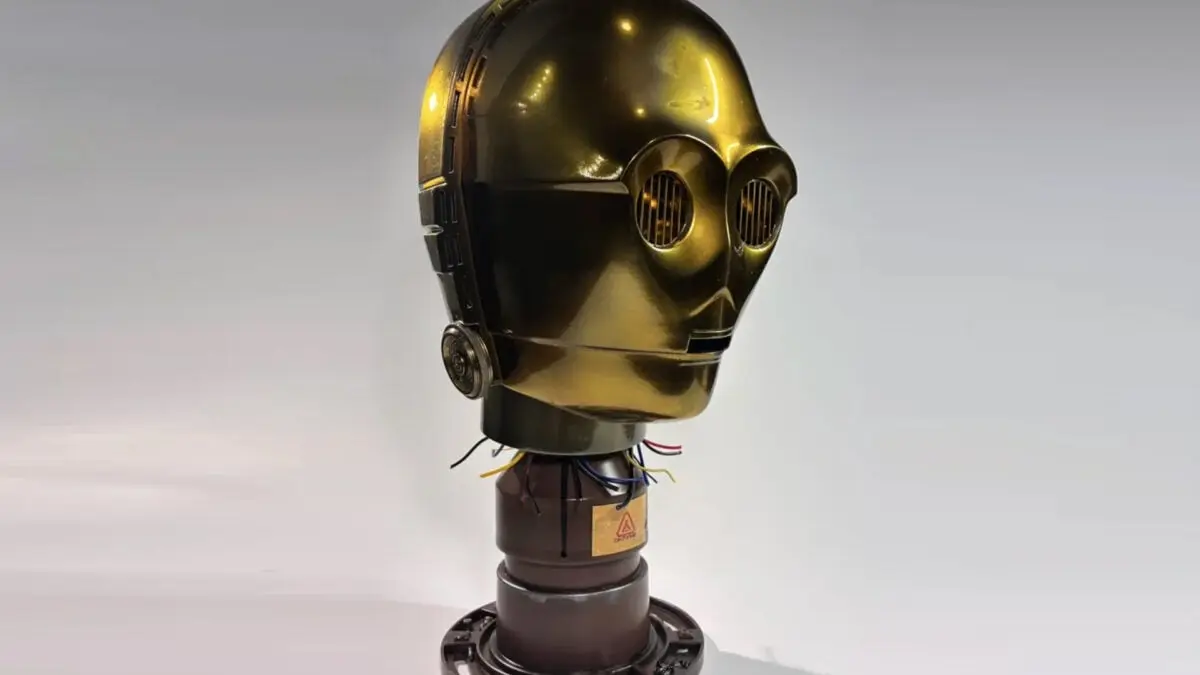
May the Fourth be with you, and all that. For Star Wars Day, we turn our attention to one of the galaxy's most underappreciated characters: C-3PO, the shiny golden protocol droid known for his fussy demeanor and impeccable grammar. While fans often cheer for the brave droids R2-D2 or the heroic Jedi, Threepio's legacy as the anxious translator who somehow survives every adventure is equally remarkable. Now, thanks to a resourceful student at Chapman University, you can bring that legacy to life—by building your own talking C-3PO head that holds real conversations, powered by artificial intelligence.
The original C-3PO head prop from The Empire Strikes Back made headlines last month when it sold at auction for over $1 million, cementing its status as one of the most expensive pieces of Star Wars memorabilia ever sold. That particular head, famously separated from its body when 3PO wanders into the wrong door in Cloud City, is now in a private collection. But if you missed your chance to own that piece of movie history, Samuel Potozkin's DIY project offers a far more affordable and interactive alternative: a fully functional, AI-driven C-3PO head that not only looks the part but can talk back to you.
The Technical Pipeline
Potozkin, a student at Chapman University in Orange County, California, recently posted a detailed video and accompanying paper on GitHub documenting his build process. The heart of the system is a Raspberry Pi 5, a compact single-board computer that handles all the heavy lifting. Here's how it works: your speech is captured by a microphone connected to the Pi. The device runs a real-time speech-to-text converter, which transcribes your words into text. That text is then sent as a prompt to a custom large language model (LLM) that has been specifically trained to emulate C-3PO's personality—prissy, pedantic, and perpetually anxious. Once the LLM generates a response, it is fed through a text-to-speech engine designed to mimic Anthony Daniels' iconic performance. The result? A head that responds to your questions with all the fussiness of the real Threepio.
Potozkin encountered a significant challenge early in development: the raw text-to-speech output simply 'did not align with the metallic vocal tone associated with C-3PO,' as he writes in his documentation. To solve this, he applied a series of audio post-processing effects that sound more like a guitarist's pedalboard than a typical software tweak. He introduced a short delay line to create tightly spaced temporal reflections, simulating the echo of a hollow metal shell. Then he layered a chorus effect by slightly modulating the time and pitch of duplicated signal paths, which creates the impression of layered vocal resonance. The result is uncanny—the voice that emerges is instantly recognizable as C-3PO, even without seeing the physical head.
Building the Head
While the AI brains are impressive, the physical construction of the head is no small feat. Potozkin likely used 3D printing and careful finishing work to replicate the golden droid's distinctive features. The head must house the Raspberry Pi, microphone, speaker, and possibly a servo mechanism for slight head movement (though the video suggests the head remains stationary). The exterior requires painting and weathering to match the glossy gold of the movies. For fans who want to attempt the build themselves, Potozkin's GitHub repository includes detailed schematics, code, and a list of components. He even offers advice on sourcing the right kind of gold paint to achieve that iconic sheen.
The project taps into a long tradition of Star Wars fan engineering. For decades, hobbyists have built everything from fully functional R2-D2 units to lightsaber replicas with realistic ignition sounds. What sets this C-3PO head apart is its integration of modern AI. Previously, a talking droid required complex animatronics and pre-recorded audio loops. Now, anyone with a Raspberry Pi and some programming knowledge can create a conversational character that responds in real time, thanks to advances in open-source LLMs and speech processing.
The Cultural Significance of C-3PO
C-3PO first appeared in the original 1977 film, Star Wars (later subtitled A New Hope), and has since appeared in all nine main saga films, as well as Rogue One, The Clone Wars, Rebels, and various other media. Anthony Daniels, the actor who has portrayed the droid from the beginning, brought a unique blend of theatricality and vulnerability to the character. Daniels insisted that 3PO never remove his costume during filming, a decision that cemented the droid's physical presence. Over the years, 3PO evolved from a comic relief sidekick to a surprisingly emotional character, especially in The Rise of Skywalker where he experiences memory loss and delivers a heartbreaking line about his friends.
The character's enduring appeal lies in his juxtaposition of elegance and cowardice. He is a protocol droid fluent in over six million forms of communication, yet he is constantly terrified of danger. This contrast makes him relatable and endlessly quotable. Potozkin's LLM presumably captures these traits, ensuring that the head complains about the humidity, worries about its circuits, and reminds you to be careful—all in perfect, stilted grammar.
Technical Deep Dive: The LLM and Audio Processing
To understand what makes this project tick, it's worth examining the software stack. Potozkin used a custom fine-tuned version of a small open-source language model, likely Llama or Mistral, optimized for dialogue and personality mimicry. Training such a model requires a dataset of C-3PO's lines from the films and EU material, annotated with the appropriate emotional tone. The speech-to-text component likely relies on a lightweight model such as Whisper, which can run on the Raspberry Pi's limited hardware. The text-to-speech engine, possibly Piper or a custom espeak variant, is then post-processed with audio effects using software like SoX or Audacity.
The choice of the Raspberry Pi 5 is interesting. It offers significantly more processing power than its predecessors, enabling real-time inference for the LLM without needing a cloud connection. This means the head can operate independently, without relying on internet access—a crucial feature for a prop that might be displayed at conventions or in remote locations. Potozkin mentions that the system achieves a response time of under two seconds, which is acceptable for conversation. Future improvements could include a more powerful model or hardware acceleration using a neural processing unit (NPU).
Audio post-processing is key to the illusion. The metallic timbre of C-3PO's voice comes from Daniels' performance being recorded through a special microphone and processed with a ring modulator. Potozkin's approach of using delay and chorus emulates that effect without requiring expensive analog gear. The 'temporal reflections' created by the delay line simulate the head's hollow interior, while the chorus adds shimmer and movement. This kind of signal processing is common in guitar effects but rarely applied to voice synthesis for character impersonation.
Broader Implications and Other Projects
Potozkin's work is part of a wave of DIY AI projects that blur the line between fan art and serious engineering. Similar builds have appeared for characters from other franchises, such as GLaDOS from Portal or the Daleks from Doctor Who. The falling cost of hardware and the democratization of AI tools mean that anyone with determination can bring their favorite fictional personality to life. This particular project stands out for its attention to detail and the quality of the voice output. It also serves as a proof-of-concept for embedding conversational AI into physical objects, which has applications beyond cosplay—think interactive museum displays, personalized assistants with distinct personalities, or toys that adapt to a child's play style.
From a technical education standpoint, the project covers multiple disciplines: mechanical design for the head, electrical engineering for the Pi and audio components, software development for the AI pipeline, and sound design for the vocal effects. Potozkin's willingness to share his work on GitHub makes it an ideal learning resource for students and hobbyists alike.
Of course, no Star Wars project would be complete without a nod to the partnership between C-3PO and R2-D2. While Threepio's head can now talk, it still lacks the ability to roll around or beep like its companion. But Potozkin hints that future iterations might include body movement or even a full body. Until then, you can enjoy the uniquely surreal experience of talking to a disembodied golden head that complains about your grammar. As Threepio would say, 'Oh dear, oh dear.'
Source:Gizmodo News